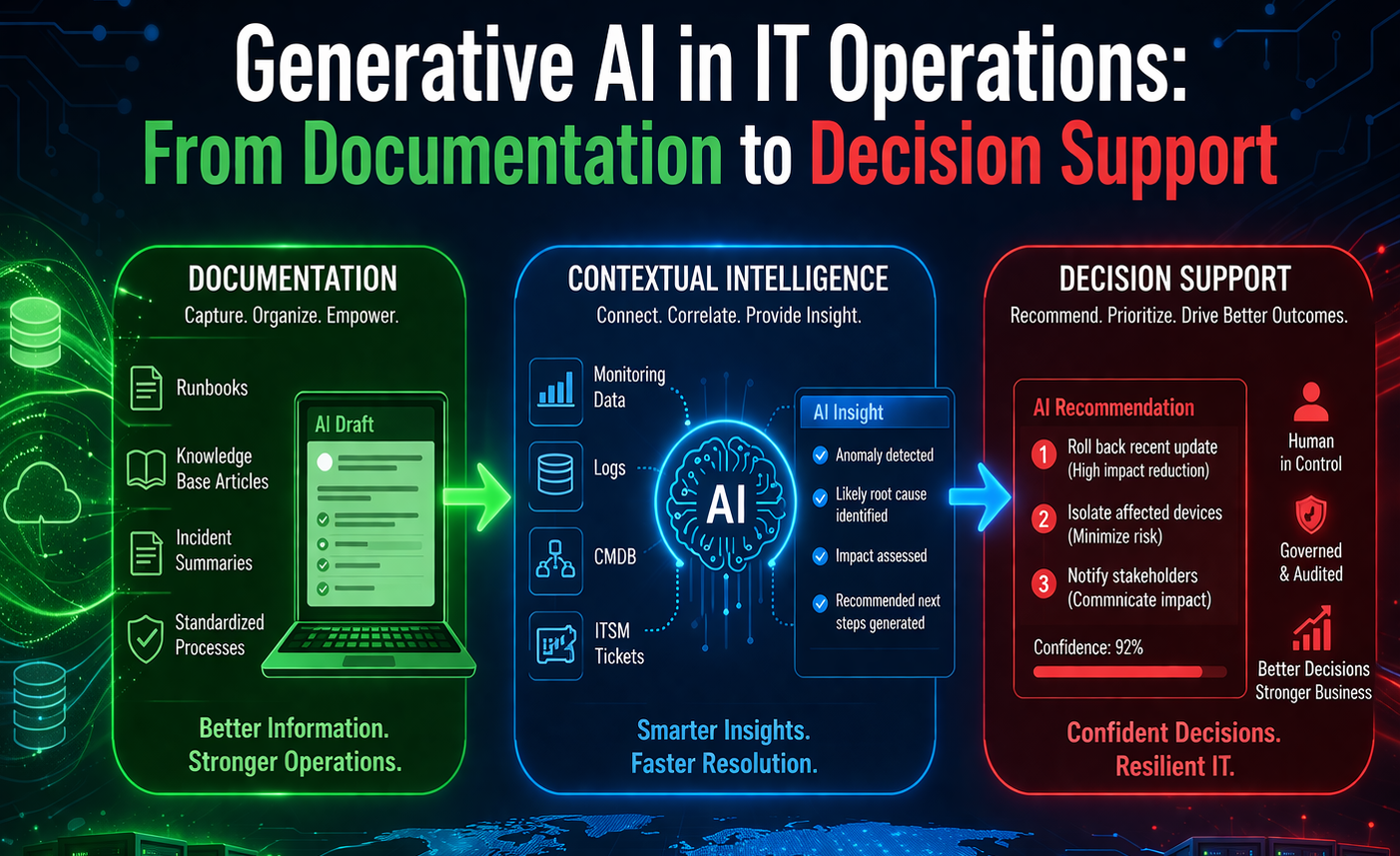
The conversation around generative AI in enterprise IT has moved well beyond experimentation. What began as a productivity tool for drafting documents and summarizing content is now evolving into something far more consequential. Generative AI is increasingly embedded within IT operations itself. It’s shifting how teams document, analyze, and ultimately make decisions. For IT leaders, the question is no longer whether to adopt generative AI. It’s how far to extend its role, and how to do so without compromising control, reliability, or governance. This transition represents a structural change in operational models. Documentation was always a foundational layer of IT operations. Now, it’s becoming a launch point for intelligence.
The Starting Point: AI as a Documentation Engine
Most organizations first encounter generative AI through documentation use cases. The value is immediate and measurable. AI can draft runbooks, summarize incident reports, generate knowledge base articles, and standardize operational procedures at scale. In environments where tribal knowledge has historically been a risk factor, this capability alone can materially improve resilience.
Consider a common scenario in a cloud operations team managing a hybrid Azure and on-prem environment. Historically, incident resolution knowledge might reside with a handful of senior engineers. When an outage occurs, resolution depends on who’s available. With generative AI integrated into the ITSM platform, incident tickets can be automatically summarized, correlated with past issues, and translated into structured knowledge articles in near real time. Over time, this creates a continuously evolving operational knowledge base without requiring manual curation. The immediate benefit isn’t just efficiency, but consistency. Documentation becomes standardized, searchable, and continuously updated. However, this is only the first phase.
From Static Knowledge to Contextual Intelligence
The real inflection point occurs when generative AI moves beyond static documentation and begins to operate in context. Instead of simply generating content, it starts to interpret operational data, correlate signals, and provide insights aligned to current system conditions. This is where integration becomes critical. Generative AI needs to be connected to telemetry sources like monitoring platforms, log aggregation systems, configuration management databases, and ticketing systems. Without this integration, AI remains a passive tool. With it, AI becomes an active participant in operations.
For example, in a large enterprise IT environment supporting Microsoft 365 and identity services, an increase in authentication failures might trigger alerts across multiple systems. Traditionally, engineers would need to manually correlate logs, review recent changes, and identify potential root causes. A generative AI system with access to these data sources can process this information instantly. It can identify that a recent conditional access policy change is the likely cause, summarize the impact, and propose remediation steps. The shift here is subtle but significant. AI is no longer documenting what happened. It is interpreting what is happening.
Decision Support in Real Time Operations
As generative AI matures within IT operations, its role expands into decision support. This is where both the opportunity and the risk increase substantially. Decision support does not mean autonomous control. It means augmenting human judgment with real time, context aware recommendations. In high velocity environments, where incident response windows are measured in minutes, this augmentation can materially impact outcomes.
Take a scenario involving a large scale endpoint management platform. A faulty update begins causing system instability across thousands of devices. The operations team is immediately faced with multiple decision paths. Roll back the update, isolate affected devices, or deploy a patch. Each option carries tradeoffs related to time, risk, and operational disruption.
A generative AI system, informed by historical incident data, current system telemetry, and dependency mapping, can present a prioritized set of actions. It can estimate the blast radius of each option, identify dependencies that may be impacted, and recommend the most effective response based on similar past events. The human operator remains in control, but the decision space is significantly compressed. This is where generative AI begins to function as an operational advisor rather than a productivity tool.
The Governance Imperative
With increased capability comes increased responsibility. As generative AI moves closer to decision support, governance becomes non-negotiable. The risks aren’t theoretical. Inaccurate recommendations, hallucinated insights, or incomplete data correlations lead to poor operational decisions at scale.
IT leaders need to establish clear guardrails around how generative AI is used in operations. This includes defining which decisions can be supported by AI, which require human validation, and how outputs are audited and validated. Transparency in how AI reaches its recommendations is critical. Black box decision support isn’t acceptable in enterprise IT environments where accountability and compliance are paramount.
There’s also a data governance dimension. Generative AI systems rely on access to sensitive operational data. This includes system configurations, security policies, and potentially regulated information. Ensuring that data access is controlled, monitored, and aligned with Zero Trust principles is essential. In practice, organizations that succeed in this space treat generative AI as part of their control framework, not outside of it.
Redefining Operational Roles and Skill Sets
As generative AI becomes embedded in IT operations, it will inevitably reshape roles within the organization. Routine tasks for documentation, initial incident triage, and basic analysis will increasingly be handled by AI. This doesn’t eliminate the need for skilled engineers. It increased the expectations. Engineers will need to operate at a higher level of abstraction and instead of spending time gathering data, they will spend time validating insights, making strategic decisions, and managing complex systems. The ability to critically evaluate AI generated recommendations becomes a core competency.
There’s also a new skill layer emerging around prompt engineering and AI orchestration within operational workflows. Knowing how to structure queries, interpret outputs, and integrate AI into existing processes will differentiate high performing teams from those that struggle to adapt. This isn’t simply a tooling shift, but a workforce transformation.
Avoiding the Trap of Over Automation
One of the most common pitfalls in adopting generative AI in IT operations is the temptation to over automate. The promise of faster resolution times and reduced human intervention leads organizations to push AI deeper into control loops than is appropriate. Operational environments are inherently complex and frequently unpredictable. Edge cases, undocumented dependencies, and rapidly changing conditions can all introduce scenarios where AI recommendations may be incomplete or incorrect. Maintaining human oversight is essential, particularly in high impact systems.
A pragmatic approach is to treat generative AI as a co-pilot rather than an autonomous operator. It should accelerate analysis and improve decision quality, but not replace human accountability. Organizations that maintain this balance will extract value without introducing unnecessary risk.
The Road Ahead: From Assistance to Operational Intelligence
Generative AI in IT operations is still in its early stages, but the trajectory is evident. What begins as a documentation tool evolves into a contextual intelligence layer, and ultimately into a decision support system embedded within operational workflows.
The long term vision extends even further. As AI models improve and integrations deepen, we’ll see the emergence of fully instrumented operational environments where AI continuously monitors, analyzes, and recommends actions across the entire IT landscape. This moves organizations closer to a state of operational intelligence, where decisions are informed by real time data, historical context, and predictive insights.
For IT leaders, the challenge is to navigate this evolution deliberately. The goal isn’t to adopt generative AI for its own sake but to enhance operational effectiveness, reduce risk, and enable teams to operate at a higher level of performance. The organizations that get this right won’t just improve their IT operations. They’ll redefine what effective IT operations looks like in an AI-augmented enterprise.