Leadership Presence in a Remote-First Enterprise

Reframing Visibility, Trust, and Influence in a Distributed World The shift to remote-first operating models has not diluted leadership presence, it has fundamentally redefined it. In a distributed enterprise, presence is no longer anchored in physical proximity or executive visibility. It’s constructed through consistency, intentionality, and digital fluency. Leaders who struggle in this environment often …

Read more

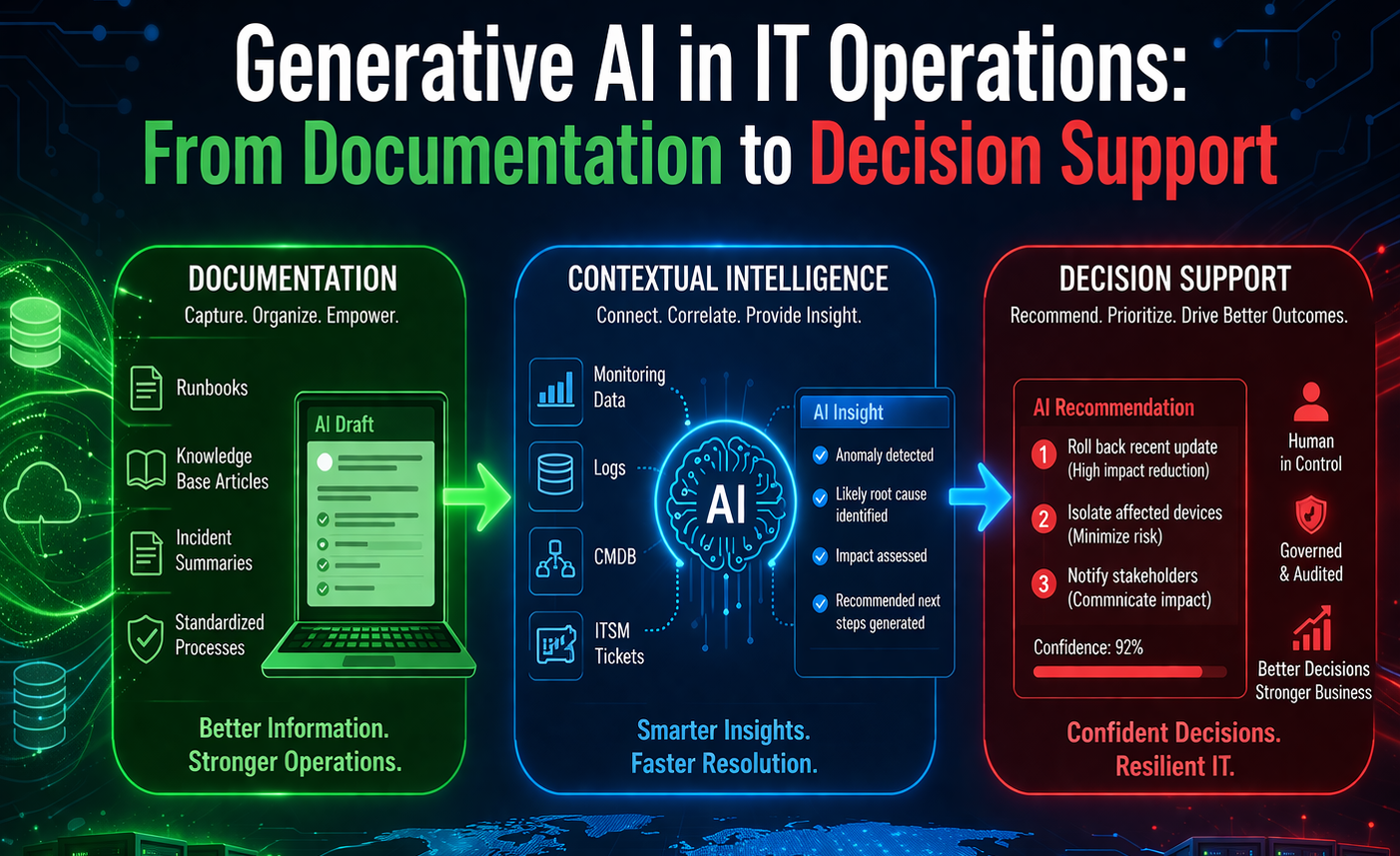
Generative AI in IT Operations: From Documentation to Decision Support

The conversation around generative AI in enterprise IT has moved well beyond experimentation. What began as a productivity tool for drafting documents and summarizing content is now evolving into something far more consequential. Generative AI is increasingly embedded within IT operations itself. It’s shifting how teams document, analyze, and ultimately make decisions. For IT leaders, …

Read more

Returning to Keystone: Honoring O.P.E.N., Service, and the Community That Made It Possible

Returning to Keystone College for the All-College Honors Convocation this year was meaningful and deeply personal. I came back to campus to accept the Edward G. Boehm, Jr. Award for Service Learning on behalf of O.P.E.N., an organization that has always represented something larger than a student group. O.P.E.N. (Opposing Prejudice, Ending Negativity) has represented …

Read more

Certifications in IT: Signal, Noise, or Something In Between?

The Credential Illusion Certifications have long been treated as a proxy for competence in the IT industry. On paper, they offer structure, standardization, and a measurable way to validate knowledge. In the right context, they have real value. They can establish baseline understanding, support early-career professionals, and signal commitment to a discipline. At the same …

Read more

The Cost of Constant Availability: Burnout in High-Performing IT Teams

The Reality Beneath High Performance High-performing IT teams are often positioned as the engine behind enterprise stability and innovation. They maintain uptime, respond to incidents in real time, and deliver against an endlessly expanding set of technical and operational demands. At a glance, these teams represent what every organization strives for. However, beneath that performance …

Read more

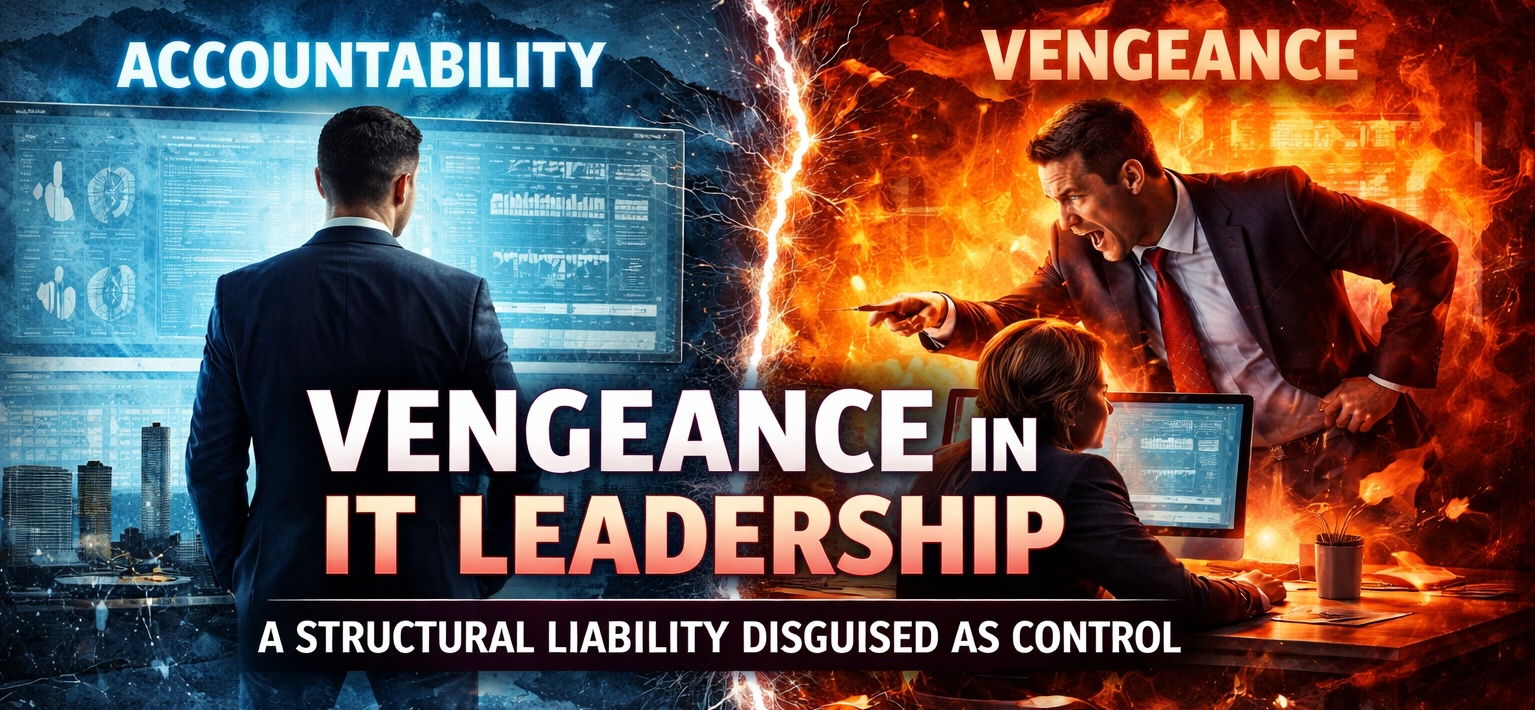
Vengeance in IT Leadership: A Structural Liability Disguised as Control

Within the many disciplines of IT leadership, the concept of vengeance is seldom addressed explicitly. It often presents itself under more acceptable terminology like accountability, decisiveness, or corrective action. However, in practice, vengeance emerges in response to high-pressure events like system outages, failed deployments, security incidents, or contractual scrutiny. In these moments, the natural inclination …

Read more

The Engineering Culture That Eats Strategy for Breakfast

You’ve heard the phrase. “Culture eats strategy for breakfast.” It gets repeated so often it’s almost lost its punch. But in technology organizations, there’s a more specific version of that dynamic worth paying attention to. It’s not culture in some big abstract sense. It’s the quiet, everyday norms that engineers follow when no one’s watching. …

Read more

A Proud Moment: Reflecting on the Legacy of OPEN at Keystone College

Twenty-two years ago, I helped start something at Keystone College that I honestly assumed would fade after I graduated. OPEN began with a simple goal. A faculty advisor, another student, and I were just trying to create a sense of community in a world that often told us who we were was wrong. We wanted …

Read more

From Invisible Burden to Strategic Lever

Understanding Technical Debt Beyond Code Technical debt is one of those terms that gets thrown around a lot, but it’s worth being precise about what it actually means. It’s not just messy code or the shortcuts your team took during a crunch. It’s the accumulated weight of every architectural compromise, every dependency that didn’t get …

Read more

The Hidden Cost of Treating IT as a Cost Center Instead of a Capability

Most organizations say technology is “strategic,” but fewer actually treat it that way. IT is still funded and managed like an expense to be minimized in practice. Budgets get squeezed. Headcount gets capped. Projects are approved only if they promise fast and tangible results. Anything that looks like maintenance, resilience, or long-term health gets pushed …

Read more

Item added to cart.
0 items - $0.00