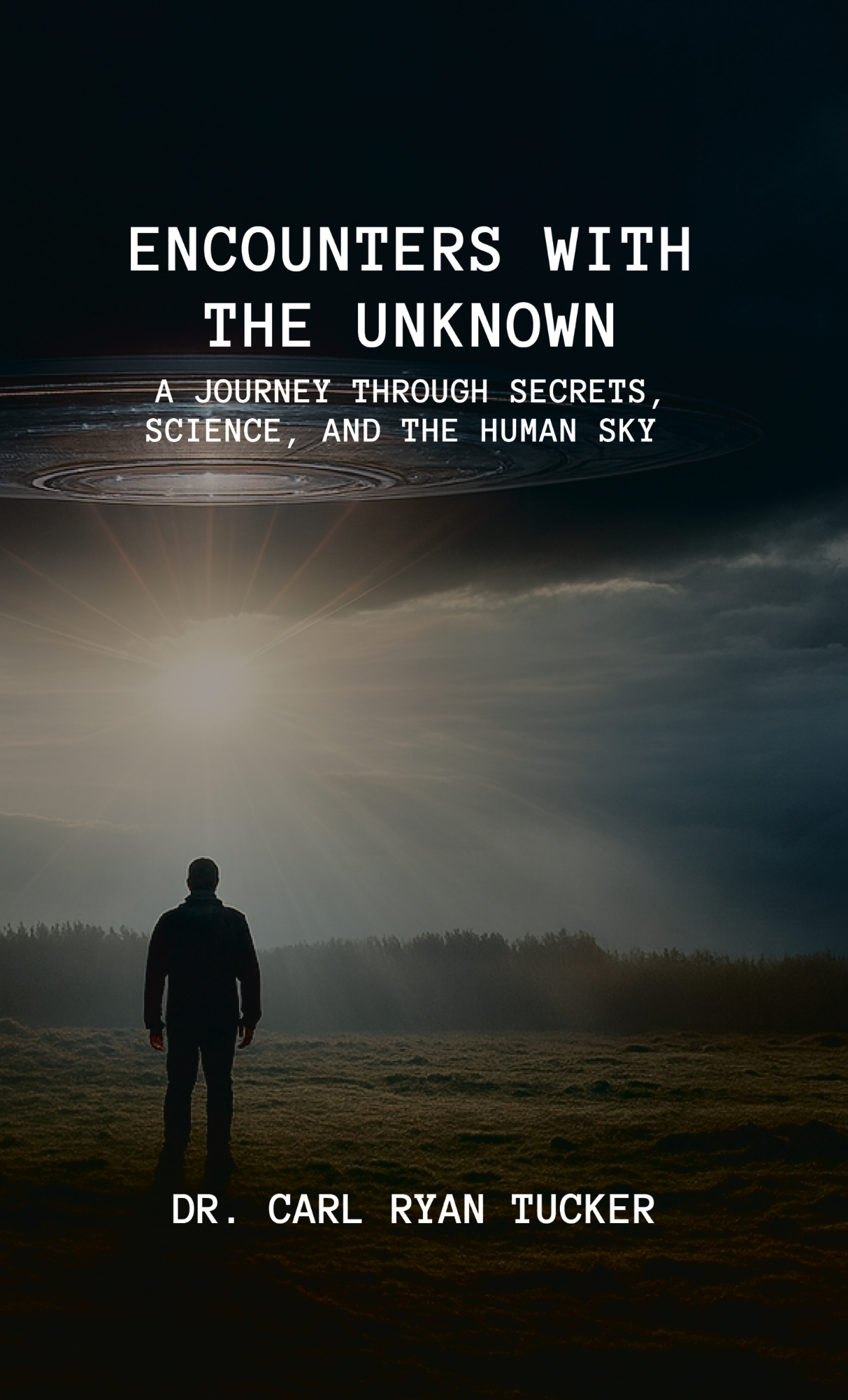
Encounters with the Unknown:
A Journey through Secrets, Science, and the Human Sky
A Journey through Secrets, Science, and the Human Sky
$39.99 + Sales Tax based on location.
Description
AVAILABLE NOW – SHIPPING GLOBALLY!
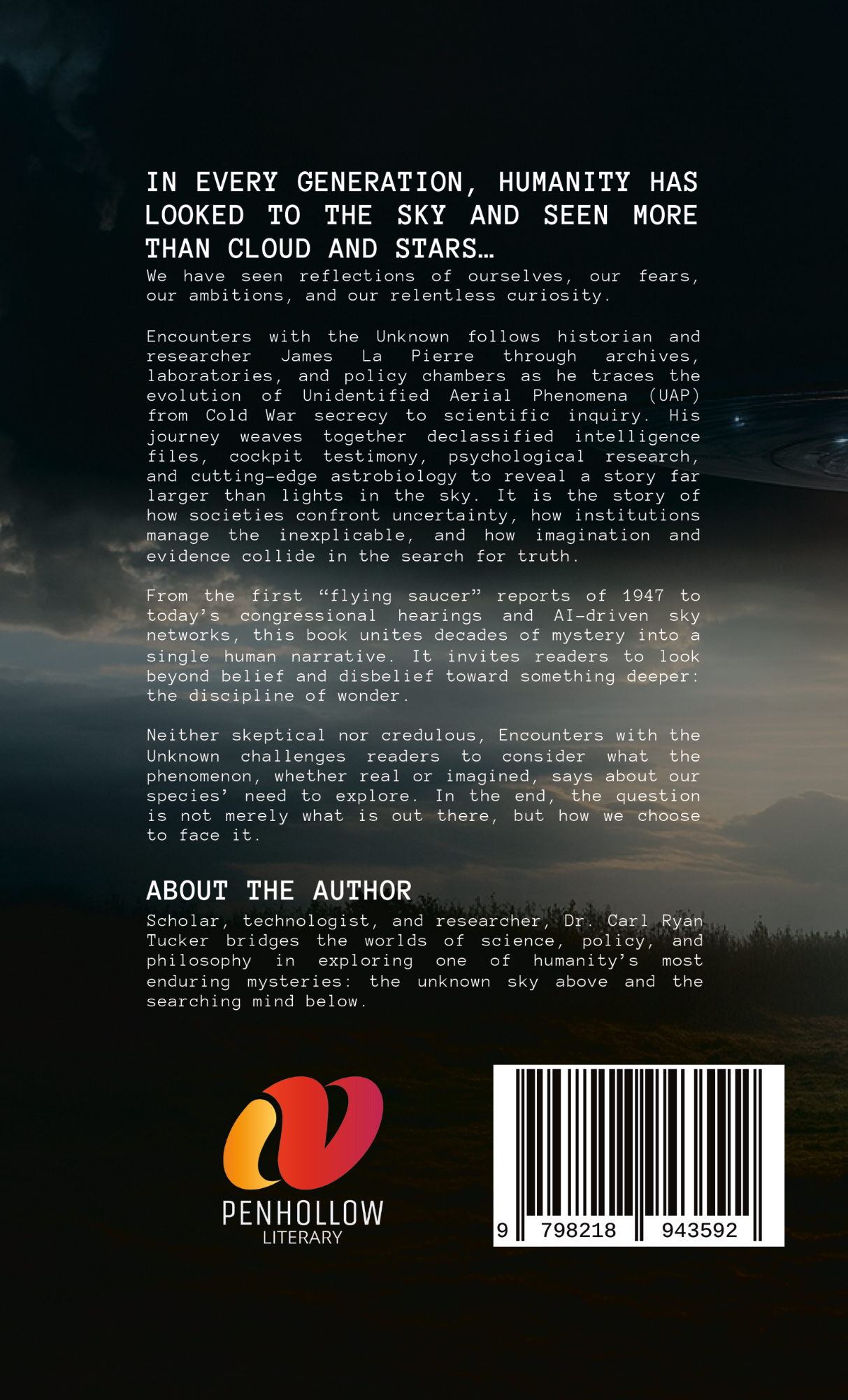
In every generation, humanity has looked to the sky and seen more than clouds and stars. We have seen reflections of ourselves, our fears, our ambitions, and our relentless curiosity.
Encounters with the Unknown follows historian and researcher James La Pierre through archives, laboratories, and policy chambers as he traces the evolution of Unidentified Aerial Phenomena (UAP) from Cold War secrecy to scientific inquiry. His journey weaves together declassified intelligence files, cockpit testimony, psychological research, and cutting-edge astrobiology to reveal a story far larger than lights in the sky. It is the story of how societies confront uncertainty, how institutions manage the inexplicable, and how imagination and evidence collide in the search for truth.
From the first “flying saucer” reports of 1947 to today’s congressional hearings and AI-driven sky networks, this book unites decades of mystery into a single human narrative. It invites readers to look beyond belief and disbelief toward something deeper: the discipline of wonder.
Neither skeptical nor credulous, Encounters with the Unknown challenges readers to consider what the phenomenon, whether real or imagined, says about our species’ need to explore. In the end, the question is not merely what is out there, but how we choose to face it.
Additional information
| Media Type | Print Book |
|---|---|
| Dimensions | Novella (5 x 8 in / 127 x 203 mm) |
| Binding Type | Case Wrap (Hardcover) |
| Ink | Standard Black & White |
| Paper | 60# Uncoated White |
| Cover Finish | Matte |
3 reviews for Encounters with the Unknown:
A Journey through Secrets, Science, and the Human Sky
A Journey through Secrets, Science, and the Human Sky
Related products
-

$25.99 + Sales Tax based on location.From Mindfulness to Mysticism:
A Survey of Meditation’s Forms, Functions, and Frontiers -

$39.99 + Sales Tax based on location.Integrated IT Leadership in Practice:
A Blueprint for Systems, Strategy, and Stewardship -

$25.99 + Sales Tax based on location.Exploring Usui Reiki:
A Historical, Clinical, and Sociocultural Inquiry -

$25.99 + Sales Tax based on location.Mysticism Across Cultures:
A Critical Examination of Esoteric Practices and Metaphysical Beliefs -

$39.99 + Sales Tax based on location.Hypnosis and Life Coaching:
Foundations, Practices, and Applications in Contemporary Wellness
Julie Fanburg –
Shaking up what we think we know. I rarely write book reviews. This one earned it. “Encounters with the Unknown” is one of Dr. Carl Ryan Tucker’s dissertations, published. I know. Stay with me.
Tucker is a Program Director leading cybersecurity infrastructure for CACI, a doctoral researcher, and an author writing on ufology.
He opens one of his powerful sections with this: “We do not see things as they are. We see them as we are.” – Anaïs Nin
That placement is not accidental. It’s the point.
At Bryn Mawr/Haverford, I studied Arendt, Malcolm X, the psychology of marginalization, silence, secrecy, and repression, and how the making of certain questions into something shameful or crazy enables institutions and systems to decide what’s sane and real, and what gets dismissed. When people become too afraid to question, or even to look, that’s not safety. It’s how things stay hidden, and progress regresses. When we stop questioning and simply accept what the hegemony declares as fact, we never learn what might actually be in the sky. We only know what someone on the ground decided to tell us. And now, as AI begins to arbitrate, that’s also worth sitting with.
Tucker is asking the same questions, not just about what’s in the sky, but about what looking up, and being told not to, reveals about us. To me, this is serious social psychology wearing a cool leather jacket.
And then Tucker does something that made me turn pages faster and wish Carl would turn this into a novel: in his section called “The Lecture That Wasn’t Supposed to Happen,” a physics professor in his corduroy jacket steps to a podium, tells the room the talk is off the record, and clicks to a still frame from a Navy cockpit video with a glowing sphere darting across an infrared display. “The question is not whether you believe. The question is whether we, as scientists, are willing to measure.”
The writing got me invested in the characters, the grappling, and what it means when secrecy becomes a precursor to tyranny.
Carl weaves together declassified intel, cockpit testimony, astrobiology, and psychological research on how humans and institutions have grappled with what they have seen in the sky across generations. Readable and rigorous in the same breath is not easy to pull off.
The inaugural Nerd Up! Award celebrates clients, colleagues, and friends making a difference through education, leadership, community, curiosity, and yes, the weird & wonderful. Tucker is the first recipient. A shaker is on its way!
Dr. Carl Ryan Tucker, thank you for sharing your early print with me.
Chris Z. –
I picked this up half-expecting breathless alien lore. What I found instead stopped me cold.
Dr. Tucker doesn’t ask you to believe anything. He asks you to think. Threading meticulous historical research through the fictional journey of James La Pierre, a skeptical historian-investigator, he makes the inquiry feel lived-in rather than performed. When James sits alone watching grainy 1952 footage, feeling both the pull of wonder and the discipline of doubt, I felt that tension personally.
The historical sections shine brightest. Tucker’s insight that U.S. secrecy around classified programs like the U-2 and A-12 Oxcart ironically generated the very UFO reports the government then denied is both darkly funny and deeply revealing. The 2023 congressional hearings chapter is the dramatic high point. When Grusch leans toward the microphone and answers yes, Tucker writes that James exhaled, pen frozen above the page. That single image captures the whole book.
Part II, where Tucker pivots to the science of observation itself, radar ducting, sensor artifacts, optical glint, is the section most UAP books never bother to write. It’s intellectually honest rather than dismissive.
My only complaint is that I wanted more. But that’s the mark of a great book.
Tucker has written something genuinely rare. Rigorous, gripping, and never sensational. The preface says it best. The mystery matters less than how we choose to engage with it.
Ryan Whitaker –
I’ve read a lot of books about UAPs over the years, and honestly, this one felt different in the best way. It didn’t come across like one of those overhyped “trust me, aliens are here” books, but it also didn’t dismiss the topic outright. It felt like having a really smart conversation with someone who’s done the homework and actually cares about the subject.
What I liked most was how balanced it was. The author looks at the history, the sightings, government involvement, witness accounts, and the bigger cultural questions without getting lost in conspiracy theories or trying too hard to convince the reader of one specific viewpoint. It made me stop and think more than once, which is pretty rare for this genre.
If you’re into UAPs, UFO history, government disclosure, or just unexplained mysteries in general, I’d definitely recommend giving this book a shot. Whether you’re a hardcore researcher or just UAP-curious after everything that’s been in the news lately, there’s a lot here to enjoy. Definitely worth the read.