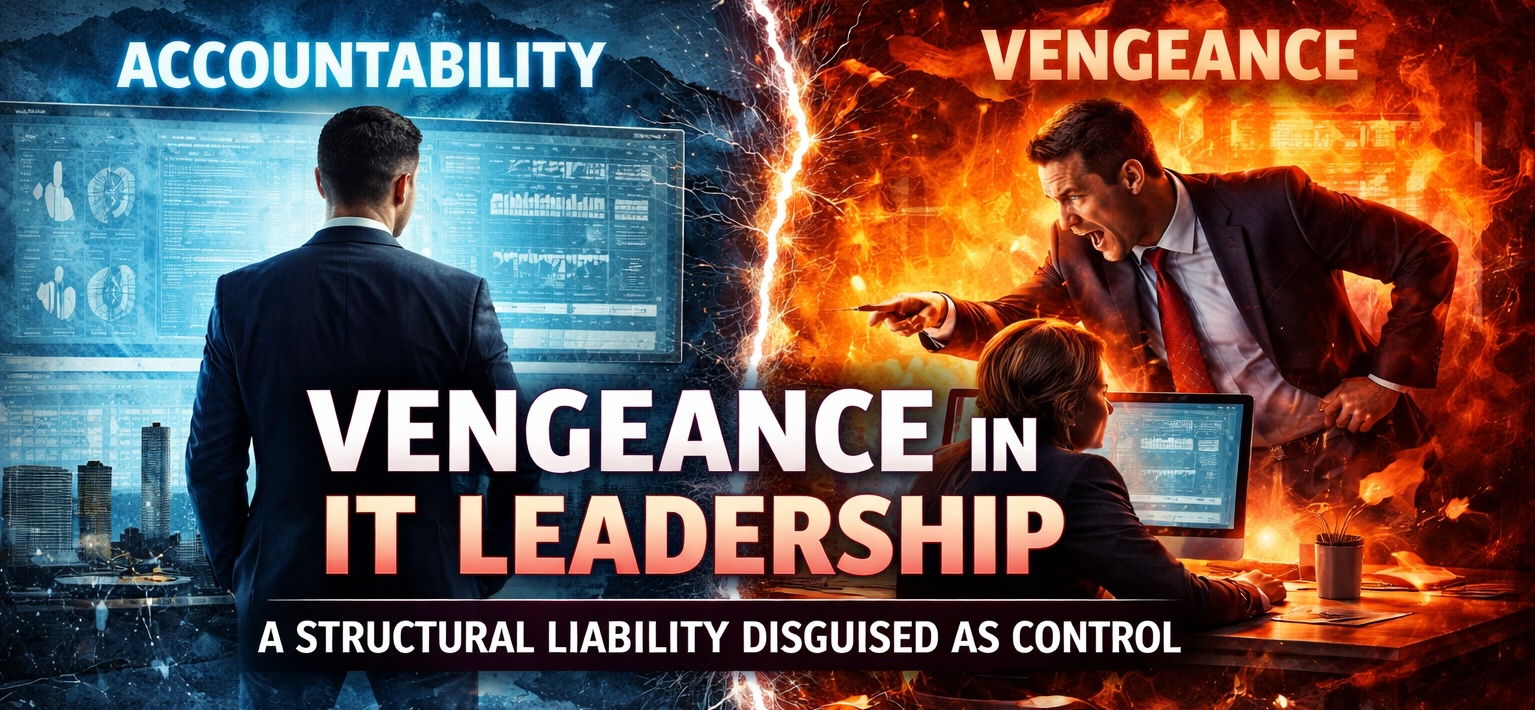
Within the many disciplines of IT leadership, the concept of vengeance is seldom addressed explicitly. It often presents itself under more acceptable terminology like accountability, decisiveness, or corrective action. However, in practice, vengeance emerges in response to high-pressure events like system outages, failed deployments, security incidents, or contractual scrutiny. In these moments, the natural inclination to identify responsibility can shift into a more punitive and emotionally driven response. This distinction isn’t merely semantic. It has material implications for organizational performance, culture, and long-term resilience.
In my experience leading large-scale IT operations, specifically in environments where mission continuity is non-negotiable, I’ve observed how quickly the tone of leadership can change under pressure. A major outage or failed migration has a way of compressing time, elevating scrutiny, and amplifying expectations from executive stakeholders. In those moments, the difference between disciplined leadership and reactive leadership becomes highly visible. The instinct to act decisively is correct. The risk lies in allowing that decisiveness to become personal rather than systemic.
Defining Vengeance in an IT Context
Vengeance in IT leadership can be defined as the application of punitive action driven primarily by emotional response rather than objective analysis. It represents a deviation from structured governance and replaces systems thinking with individualized blame. In contrast to disciplined accountability, which is evidence-based and forward-looking, vengeance is reactive and retrospective. It seeks to assign fault rather than to understand causality. This shift alters the fundamental question from “What failed within the system?” to “Who is responsible for this failure?” Such a reframing introduces bias into decision-making and undermines the integrity of technical and operational processes.
I’ve seen this shift occur in subtle ways. In one instance, following a high-visibility service degradation tied to a cloud configuration change, the immediate reaction from a senior stakeholder was to identify the individual engineer responsible for the change. The assumption was that isolating accountability at the individual level would demonstrate control. However, as we conducted a deeper analysis, it became clear that the issue was not a single misstep. It was a combination of insufficient guardrails, gaps in change validation, and an overreliance on manual processes within an otherwise automated pipeline. The system had failed long before the individual action occurred. Treating it as an individual failure would have obscured the real problem.
Operational Consequences of Vengeance-Driven Leadership
The presence of vengeance within leadership behavior produces several predictable and measurable consequences across IT organizations. When team members anticipate punitive outcomes, they’re less likely to surface complete and accurate information during incident response. Post-incident reviews become constrained by self-preservation behaviors, resulting in incomplete root cause analyses and the persistence of unresolved failure modes. In parallel, a punitive environment discourages calculated risk-taking. Engineers and architects avoid proposing optimizations, architectural changes, or process improvements due to the perceived personal cost of failure, which results in stagnation within systems that require continuous iteration to remain effective.
I’ve witnessed this dynamic develop over time in organizations where leadership responses to failure were inconsistent. In one environment, a series of highly publicized escalations led to increasingly defensive behavior across teams. Engineers began documenting excessively, not for clarity, but to cover their ass. Meetings shifted in tone, with participants carefully choosing language to avoid perceived blame. The technical discussions became less candid and, less effective. The organization didn’t lose capability overnight, but it did lose velocity and openness, which are far more difficult to restore.
Over time, this environment contributed to accelerated talent attrition. High-performing personnel tended to exit the organization where mistakes were treated as liabilities rather than learning opportunities, leaving behind a workforce that prioritizes compliance over innovation. This shift ultimately reduced the organization’s ability to adapt and evolve. Additionally, a culture influenced by vengeance delayed the escalation of issues, as individuals hesitated to report emerging problems early. This increased the likelihood that minor defects evolved into major incidents, particularly where reliability and security were critical.
The Distinction Between Accountability and Vengeance
It’s essential to differentiate vengeance from structured accountability, as the two are often conflated in practice. Accountability is characterized by evidence-based evaluation, system-level analysis, and forward-looking remediation strategies that align with established frameworks. Think of ITIL, DevSecOps, and enterprise risk management models. It’s designed to improve systems and strengthen organizational capability over time.
Vengeance, in contrast, is characterized by emotionally driven responses, individualized blame assignment, and retrospective justification of punitive action. It places limited emphasis on systemic improvement and instead focuses on identifying and penalizing perceived fault. High-performing IT organizations rely on accountability mechanisms that emphasize causality, control effectiveness, and continuous improvement rather than personal attribution.
In practice, the distinction often becomes clear in how post-incident conversations are conducted. In accountable environments, the discussion centers on sequence of events, contributing factors, and control effectiveness. In vengeance-driven environments, the discussion centers on decisions, individuals, and perceived mistakes. I’ve intentionally shifted conversations in real time by reframing questions. Instead of asking who approved a change, I ask what validation mechanisms were in place and whether they performed as expected. That shift alone can redirect the entire tone of the discussion.
Leadership Maturity Under Pressure
The emergence of vengeance is often correlated with leadership behavior under stress. In environments where leaders are subject to executive scrutiny, regulatory oversight, or contractual accountability, there is often pressure to demonstrate control and decisiveness. In such contexts, punitive actions can create the appearance of strong leadership. However, this perception is superficial and doesn’t translate into operational stability.
Effective leadership is demonstrated through the ability to maintain objectivity, preserve team cohesion, and implement systemic improvements under pressure. Mature IT leaders understand that credibility isn’t built through visible punishment, but through consistent system performance, transparent communication, and the ability to absorb pressure without displacing it onto the team.
There have been moments in my own leadership journey where the pressure to respond quickly was significant, particularly during enterprise-wide migrations with visibility at the executive level. In those situations, the most important decision wasn’t the technical fix. It was the tone set with the team. Choosing to focus on stabilization first, followed by structured analysis, reinforced trust and ensured that the response remained disciplined. The outcome wasn’t only a resolved incident, but a stronger system and a more confident team.
Implications for Enterprise and Federal IT Environments
In large-scale enterprise and federal IT environments, the risks associated with vengeance-driven leadership are amplified. These environments are characterized by complex system interdependencies, stringent compliance requirements, and mission-critical service delivery expectations. A leadership approach that discourages transparency or delays escalation introduces systemic vulnerabilities that compromises both operational effectiveness and compliance posture.
In federal environments specifically, where alignment with mission objectives and stakeholder trust are paramount, the margin for cultural dysfunction is extremely narrow. I’ve seen how quickly communication pathways can degrade when teams begin to second-guess whether raising an issue will result in negative consequences. When that hesitation enters the system, it becomes a risk vector in itself.
Such environments require rapid issue identification, accurate reporting, and structured remediation processes. When individuals feel constrained by fear of punitive response, these processes break down. This not only increases operational risk but also erodes stakeholder trust, which is essential in both enterprise and government contexts.
Operationalizing Disciplined Accountability
To mitigate the risks associated with vengeance, IT leaders have to formalize accountability mechanisms within their organizations. This begins with the establishment of blameless post-incident review processes that focus on system conditions, contributing factors, and control gaps rather than individual fault. These reviews need to be structured, repeatable, and consistently applied to ensure integrity.
In practice, I’ve implemented review models where the first phase is strictly fact-finding, supported by logs, metrics, and timelines, with no attribution of fault. Only after the system narrative is fully understood do we move into remediation planning. This sequencing matters because it preserves objectivity and prevents premature conclusions.
In addition, organizations must clearly separate incident analysis from performance management discussions. This distinction preserves the objectivity of technical reviews while allowing performance issues to be addressed through appropriate and independent channels. All findings and remediation actions need to be grounded in evidence, supported by data, logs, and observable system behavior.
Leadership evaluation should also incorporate how leaders respond to failure, not solely the outcomes they produce. This reinforces the importance of fostering transparency and continuous improvement. Most critically, leaders have to model the behavior they expect. When failures occur within their domain, they need to demonstrate ownership of system-level outcomes, reinforcing that accountability begins at the top and flows through structure rather than emotion.
What it comes down to…
Vengeance may present itself as a form of decisive leadership, particularly in high-stakes situations. However, within the context of IT leadership, it represents a structural liability. It undermines trust, distorts analysis, and weakens the organization’s capacity to learn and adapt. In contrast, disciplined accountability strengthens systems, enhances transparency, and supports long-term resilience.
Failure within IT systems are inevitable. The effectiveness of leadership is defined by the quality, discipline, and integrity of the response, not the absence of failure. The leaders who build enduring, high-performing organizations are those who resist the pull of reaction and instead commit to systems thinking, even when the pressure to do otherwise is at its highest.