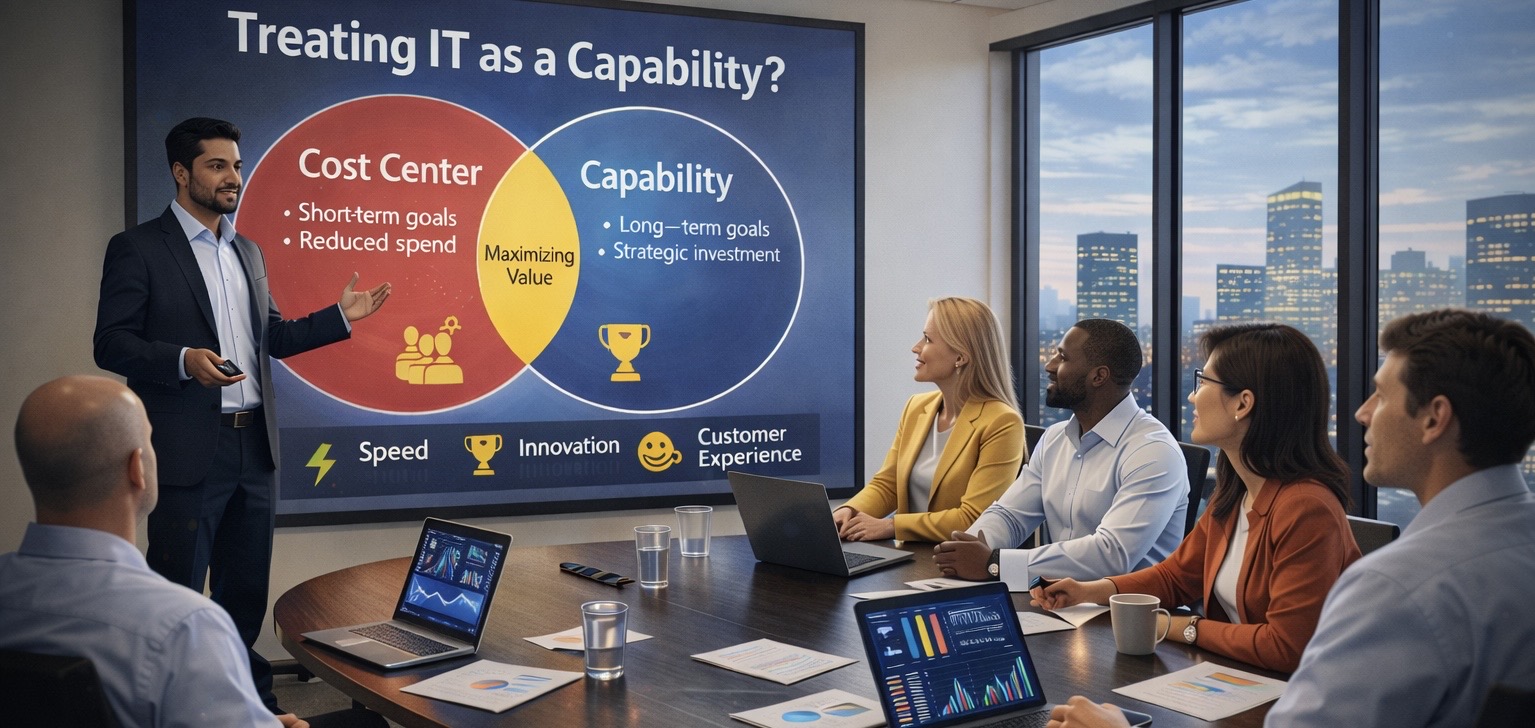
Most organizations say technology is “strategic,” but fewer actually treat it that way.
IT is still funded and managed like an expense to be minimized in practice. Budgets get squeezed. Headcount gets capped. Projects are approved only if they promise fast and tangible results. Anything that looks like maintenance, resilience, or long-term health gets pushed to “later.”
That mindset carries a cost. It just doesn’t show up where leaders expect to see it.
When IT is treated as a cost center, systems are expected to behave like critical infrastructure but are funded like temporary tools. Email, identity, networks, core platforms, data pipelines – they all get treated the same way. These are all foundational to the business, yet they’re often managed as if they’re interchangeable utilities. The result is a slow buildup of “fragility”what’s going to happen today” that only becomes obvious when something fails.
One common place this shows up is project-based funding. A team gets money to “deliver the thing.” Once it gets delivered, the funding stops. There is never any budget for ongoing care, refactoring, or scaling, which over time, forces the system to live in production but in a kind of financial limbo where if it costs anything to keep it alive, the question becomes “what did you do?” No one gets paid to improve it. No one is rewarded for keeping it healthy. But, years later, leadership wonders why every change is expensive and risky.
Another example is headcount minimization. When IT staffing is driven purely by cost targets, teams are stretched thin. They spend most of their time keeping the lights on. Preventive work never gets addressed because outages, tickets, and deadlines always become more and more urgent. The organization shifts from proactive to reactive. That’s not because people are bad at their jobs. It’s because the system they are working in makes long-term thinking impossible.
You also see this in vendor decisions. When cost is the primary driver, organizations often choose tools that are cheaper upfront but harder to integrate, customize, or scale. At first, it looks like a win, but over time, those savings are erased by workarounds, manual processes, and faulty integrations. The business ends up paying interest on the original “savings” in the form of slower delivery and higher operational risk.
Mergers and acquisitions are another pressure point. Technology integration is usually framed as a necessary evil rather than a strategic investment. Teams are told to “just make it work” under aggressive timelines and extremely tight budgets. Systems get stitched together instead of redesigned to accommodate the new business. Redundancies pile up. Data becomes fragmented. And years later, the organization is still paying for a rushed integration that leadership no longer remembers approving.
Treating IT as a cost center also shapes culture in subtle ways. When leaders focus almost exclusively on reducing spend, teams learn that stability, security, and maintainability aren’t valued outcomes. What matters is delivering something tangible quickly and cheaply. That culture produces exactly what it incentivizes. Shortcuts become normal, documentation disappears, and architecture decisions get made under pressure instead of with intention.
The irony is that this mindset often undermines the very business goals that leaders care about. Speed suffers because systems become unreliable. Innovation slows because change becomes too risky. Customer experience degrades because outages and inconsistencies increase. What looked like cost control at inception turns into a drag on competitiveness and sustaibability.
Organizations that treat IT as a capability think differently. They fund platforms instead of just funding projects. They invest in system health the same way they invest in talent development and risk management. They accept that some work will never be customer-visible but is still 100% business-critical. They ask “How much does this cost?” and “What does this enable us to do next?”
This doesn’t mean spending blindly or chasing the newest technology. It means recognizing that technology isn’t just something the business uses. It’s something the business is built on. When leaders make that shift, technical debt becomes easier to manage, teams become more effective, and the organization regains its ability to move without constant outages.
The real cost of treating IT as a cost center isn’t higher budgets. It’s missed opportunities, slower adaptation, and systems that quietly work against the business they’re supposed to support.