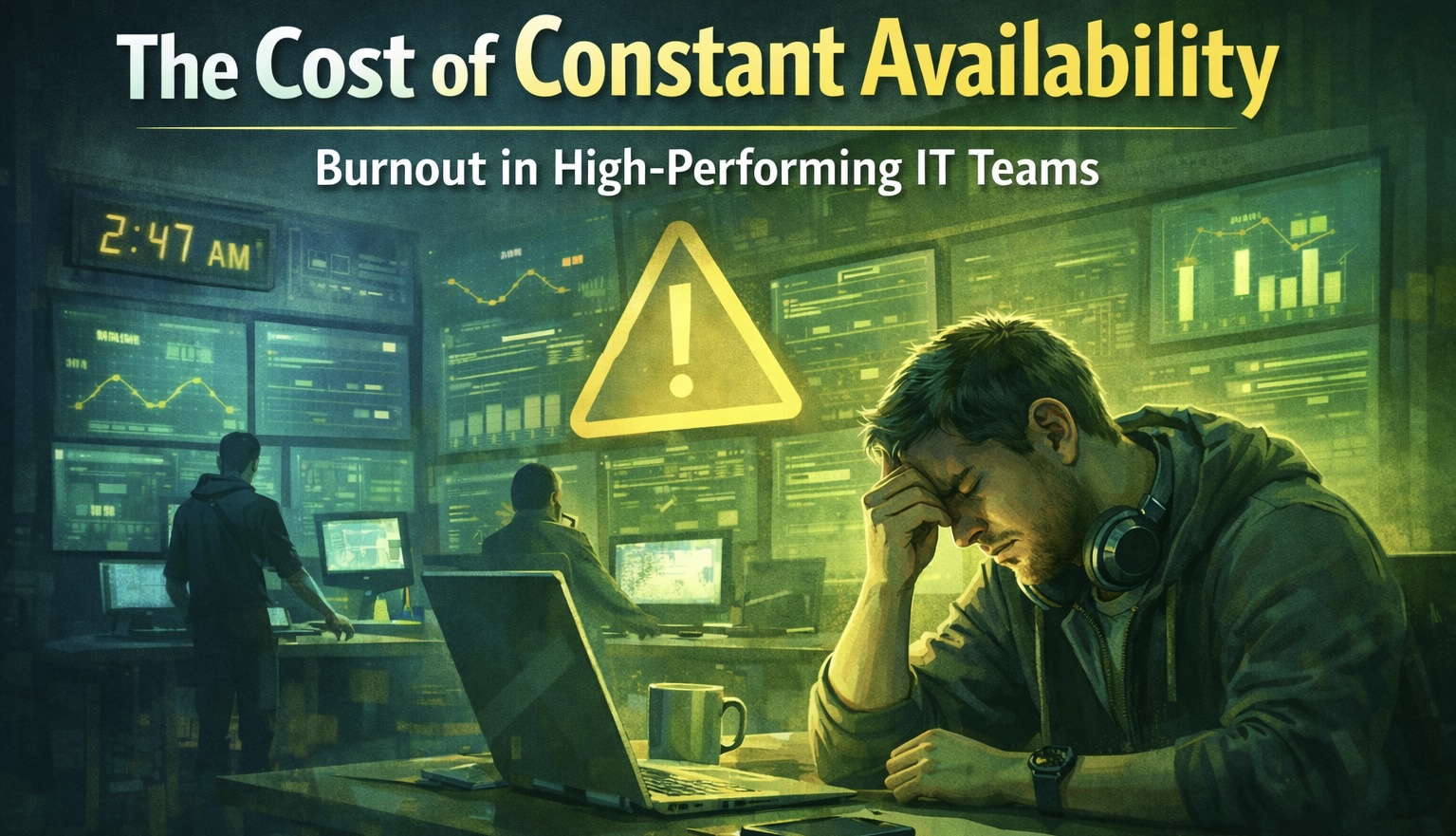
The Reality Beneath High Performance
High-performing IT teams are often positioned as the engine behind enterprise stability and innovation. They maintain uptime, respond to incidents in real time, and deliver against an endlessly expanding set of technical and operational demands. At a glance, these teams represent what every organization strives for. However, beneath that performance is often an unsustainable pace that quietly degrades both effectiveness and retention over time. Burnout in these environments isn’t incidental. It’s a byproduct of how the organization is structured, how success is defined, and how leadership reinforces expectations.
The High-Performance Paradox and the Culture of Availability
There’s a consistent paradox at the center of high-performing IT organizations. The teams that deliver the most value are frequently the ones placed under the greatest and most persistent strain. Success generates trust, and trust leads to increased demand. That demand, if not managed deliberately, becomes pressure. Over time, that pressure is normalized as part of the operating environment. What begins as occasional urgency evolves into a constant state of readiness, where after-hours work, weekend escalations, and continuous monitoring are no longer exceptions but expectations.
Constant availability is rarely formalized as a requirement, yet many organizations create conditions where it becomes the default mode of operation. This is reinforced through subtle cultural signals, like praising individuals who respond at all hours, celebrating rapid incident recovery without examining root causes, and implicitly valuing visibility over sustainability. Over time, availability becomes equated with commitment, and commitment becomes conflated with performance. This creates a dependency model where systems rely not on engineered resilience, but on human vigilance. In that model, the organization isn’t scaling its capabilities. It’s scaling its reliance on people.
The Hidden Cost to Performance and Retention
The cost of this approach is both immediate and long term. Burnout is often framed as an individual challenge, but in reality it’s an organizational signal that something is misaligned. Sustained fatigue degrades decision-making quality and reduces the ability to think strategically. Teams become reactive rather than proactive, focusing on maintaining operations rather than improving them. Documentation and knowledge transfer suffer because there’s no space to formalize what’s known. Over time, risk increases as exhausted engineers are asked to manage critical systems under pressure.
The most significant impact, however, is on retention. High-performing individuals have options, and when the environment becomes unsustainable, they leave. What they take with them isn’t easily replaced, and the burden on the remaining team increases, accelerating the cycle.
Leadership Accountability and Redefining Performance
Retention in this context isn’t a function of perks or morale initiatives. It’s a direct reflection of leadership decisions. Leaders define the environment in which teams operate, and when that environment produces burnout, the responsibility sits at the leadership level. This requires a deliberate shift in how performance is defined and measured. If responsiveness is rewarded more than resilience, teams will optimize for being constantly available. If uptime is prioritized without addressing systemic issues, teams will remain in a cycle of firefighting. If constant escalation is accepted as normal, it becomes embedded in the culture.
Reframing performance is a critical step in addressing this issue. High performance in IT shouldn’t be defined by how quickly teams respond to problems or how many hours they are available. It should be defined by the ability to deliver consistent, reliable outcomes without degrading the team itself. This means shifting the focus toward engineering resilience, automating repetitive operational tasks, and investing in systems that reduce the need for human intervention. It also requires establishing clear boundaries around on-call responsibilities and ensuring that recovery time is treated as essential, not optional. In this model, success is measured by the absence of recurring issues and not by the frequency of heroic recoveries.
Designing for Sustainability
Building sustainable IT teams requires aligning expectations with the realities of human capacity and system complexity. Human cognitive load isn’t infinite, and sustained pressure inevitably impacts performance. Leaders need to design operating models that account for this, incorporating structured on-call rotations, enforced downtime, and capacity planning that reflects both project and operational demands. It also requires a commitment to addressing root causes through continuous improvement, rather than accepting recurring incidents as part of the landscape. These are structural changes that directly influence both performance outcomes and workforce stability.
Concluding Thoughts
Burnout in high-performing IT teams isn’t an unavoidable consequence of demanding work. It’s a signal that the system itself requires redesign. Effective leaders recognize that when teams are consistently stretched, the issue isn’t a lack of dedication. It’s a misalignment between expectations, architecture, and operating model. Leadership accountability in this context means asking more difficult questions and being willing to address systemic issues rather than relying on individual effort to compensate.
The long-term performance of any IT organization depends on whether those teams can continue to perform tomorrow and not just on what its teams can deliver today. The measure of leadership isn’t how much a team can endure under pressure. It’s whether the organization has created an environment where high performance can be sustained without exhausting the people responsible for delivering it.