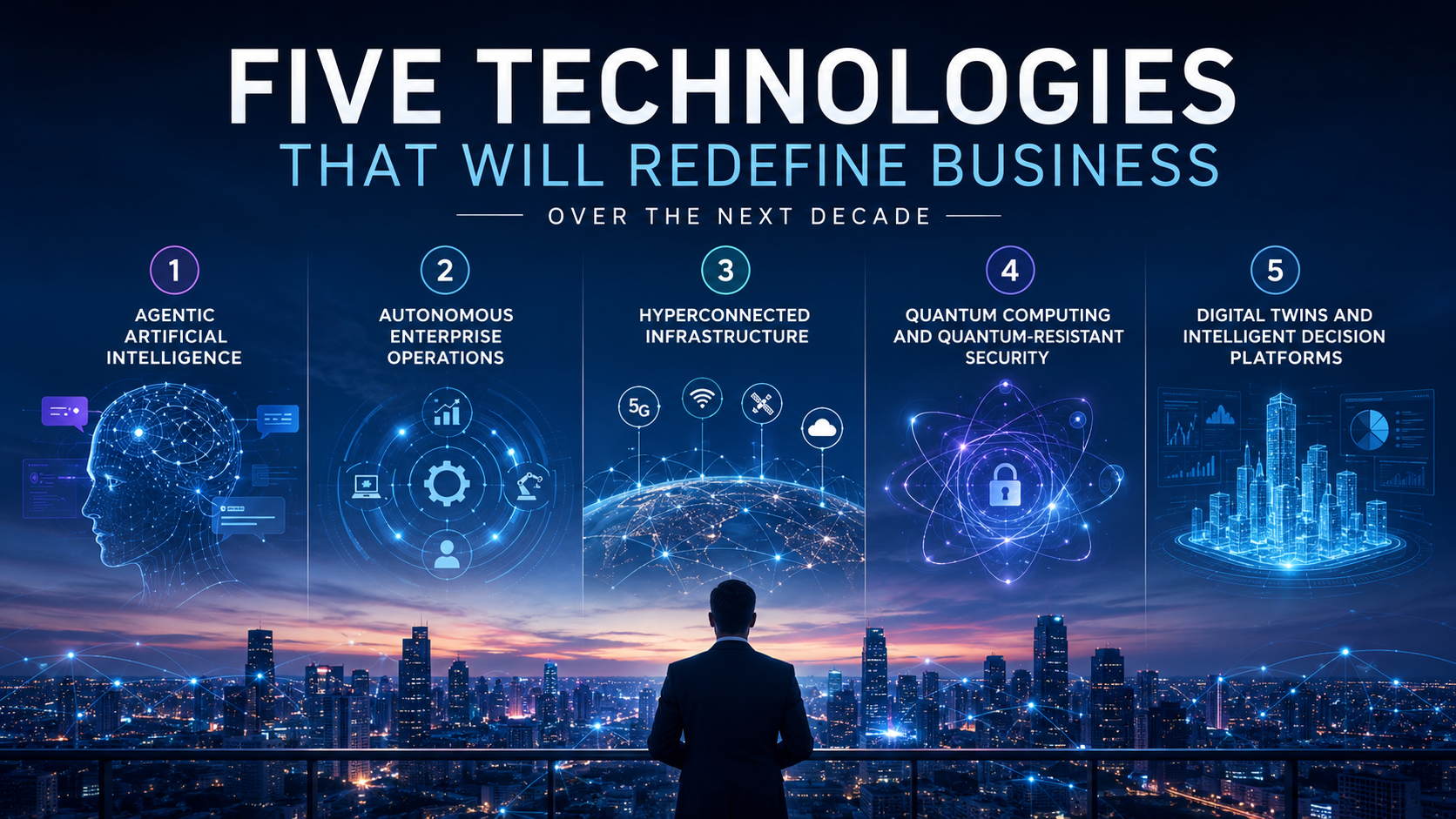
My observations on successful long-term existence in the high paced world of technology are quite simple. No matter how much money one throws at the problem, having the biggest and the best technology is not sufficient. A company must recognize change early enough and change fast enough. Most importantly, technology must be driven as a business driver as opposed to just another IT system to keep up and running.
Another technology shift is looming – AI, automation, quantum computing, digital twins, next-generation networking. These technologies will not remain in the lab and by themselves or in combination with other technologies significantly change the ways of competition and the sources of value for businesses (Vial, 2019).
My view is that over the next 10 years it will not be the first to market with new technology that will end up as a long term performer. It will be the organization with a clear strategy for using the many emerging technologies; an organization with a workforce that is able to put these technologies to work; and an organization with the right governance and accountability in place to really allow for true innovation to happen. This view is similar to that expressed by the World Economic Forum (2019) in their “Future of Work” study. Below is a more detailed look at 5 emerging technologies and their impact on business over the next decade.
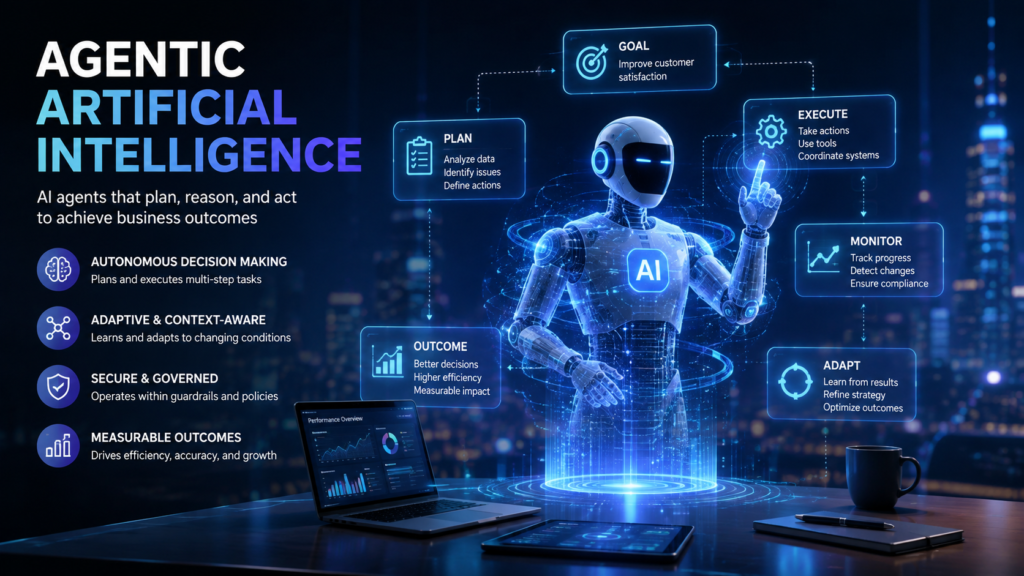
While business leaders have been experimenting with using generative AI to boost productivity, there is far greater potential in AI than has so far been unlocked, particularly as the technology advances to become agentic AI. This is to say systems that are ‘set a goal’ and then allow users to manage within set boundaries as the AI autonomously completes tasks and processes.
Generative AI are designed to complete a specific task based on input or a prompt, and once that task has been completed by the AI system, the AI ceases to function until more input is provided or a new task is assigned to the AI system. Therefore, generative AI function akin to advanced search engines or other productivity tools that assist humans with writing tasks, and they cease to function once the results of their efforts have been delivered to the human who used the AI system to complete a task. In contrast, agentic AI are designed to function within parameters established by a human operator over an extended period of time. In doing so, the AI system may complete a number of related tasks or a single complex task and, in doing so, the AI system may effect change within the parameters established by the human operator for the AI system.
Again, a more realistic example of how an agentic AI could support senior managers within an organization would be for such a system to gather all relevant data from throughout an organization (e.g. from HR systems; from financial systems; from customer relationship management systems etc.) and then use that data to analyze a variety of different key performance indicators; to identify potential risks and threats to an organization; and then to create the slides for a quarterly board presentation. The AI system could then go on to coordinate reviews of the slides created by the AI for the board presentation with relevant stakeholders within an organization; schedule meetings etc. Finally, the AI system could even follow up on action items after meetings have taken place. Such an AI system would be able to handle a large proportion of the work required to create a board presentation, thereby freeing up senior managers within an organization to concentrate on more valuable activities. This is more than a matter of increased productivity however. It is a completely new way of working with knowledge in order to take decisions within an organization.
The scope of Agentic AI extends way beyond the Boardroom, with areas such as Cybersecurity, continuously monitoring a network of computers for cyber threats, utilizing the latest threat intelligence from a variety of sources. Once a breach of security is identified, the system could automatically isolate the part of the network that has been compromised, analyze what has occurred, automatically create an incident report and then recommend the best course of action to resolve the problem. This would all happen before an analyst had even started to look into the incident. The Finance function could have an agent that automatically reconcile a very large number of transactions, completed on a daily basis, undertake the financial forecasting for a business, highlighting any unusual activity that could potentially be a fraud. The system could also automatically create complex dashboards for the Executive team to aid their strategic decision making. Some of the early adopters of these types of AI-powered agents are the Engineering functions who are using the technology to automatically write code, run very large numbers of automated tests for functionality and security, to identify potential areas of vulnerability and to ensure that the documentation for a system under development is always up to date.
Brynjolfsson et al. (2023) surveyed professionals who currently use Generative AI at work to examine their perceptions of its value. The results of the study showed that when professionals used Generative AI to support their work and enhance their own expertise, they reported significant increases in both their productivity and the quality of work that they were able to complete. In contrast, when they used it to complete tasks and work instead, they reported decreased levels of both metrics. Their findings led the authors conclude that while AI will undoubtedly replace some human work, it is likely to prove to be a powerful tool for professionals in augmenting the work that they currently do. Indeed, the greatest value that any professional is likely to derive from the use of Generative AI will come from its ability to free them from administrative work and enable them to devote more time to difficult, complex, high value-added tasks, to make sound decisions, and to collaborate with their colleagues to generate new ideas and to solve problems that would otherwise be beyond their capability to solve.
However, as the intelligent systems evolve and become increasingly more sophisticated, they must be used responsibly. In order to benefit from the use of autonomous AI systems, companies will need to develop governance models, ensure accountability, transparency, and protect their employees’ personal data and the company’s Intellectual Property (IP). Additionally, companies will need to ensure that they comply with various regulations. Addressing these challenges proactively is key to the successful use of AI systems at work. As noted by WEF (2025), as AI systems start to operate without human intervention, governance will become even more critical.
Ultimately, putting agentic AI to work will depend on having good business processes in place to leverage the technology. It will require a new way of working with the AI as a partner. Employees and leaders alike will need to get better at working with the technology. As is the case with any powerful technology, there will be a lot of hype around the latest model and newest tool, but in the end, it is how you implement the technology that matters. You can leverage the powerful capabilities of agentic AI to create far greater results than would be possible by either person or technology alone.
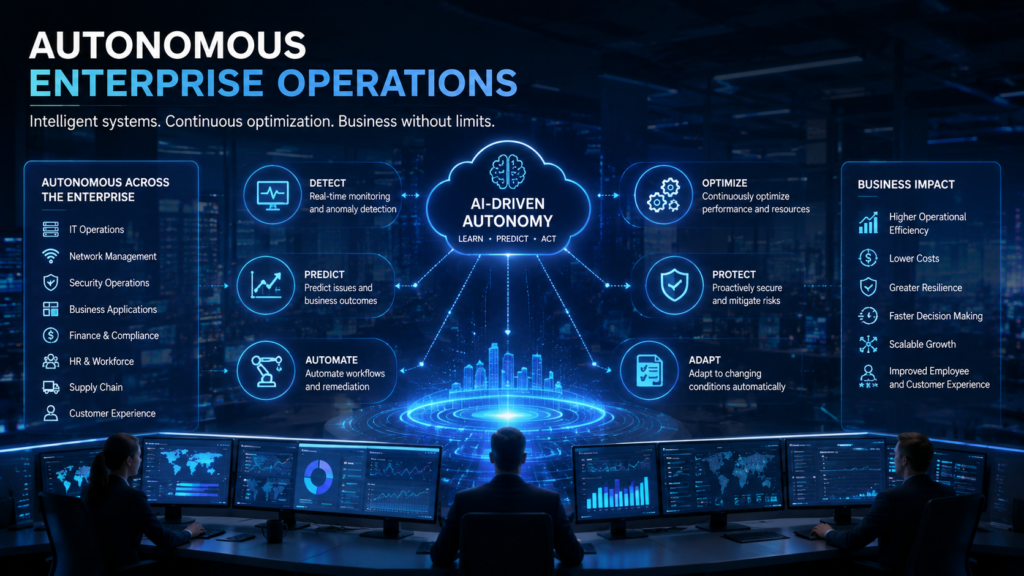
Modern companies have followed a standard pattern of enterprise management for decades. The IT system would indicate a problem, which the IT staff would investigate to determine the cause. Once determined, they would work as fast as possible to fix the problem to prevent too much disruption to users. Automation and business process management (BPM) of the main part of IT operations has become more efficient by allowing for more efficient handling of normal day to day tasks. However, the majority of automated processes are fixed and follow a strict predefined process and need to be monitored and fine-tuned on an ongoing basis.
Enter the convergence of Artificial Intelligence (AI), Predictive Analytics, Robotic Process Automation (RPA) and AIOps (Artificial Intelligence for IT Operations) into the Enterprise IT mix (Sarker, 2022). The emerging model of enterprise operations – called Autonomous Enterprise Operations – will be able to anticipate problems that have yet to occur. Instead of waiting for a problem to occur in the first place and then deal with the consequences of that failure, Autonomous Enterprise Operations identify patterns of activity of which the organization was previously unaware. The system uses the information it gathers to anticipate problems and thus take action to prevent them from occurring and causing harm to employees and customers of the enterprise. Autonomous Operations are thus not merely reactive – they are predictive in nature allowing the enterprise to become more autonomous in terms of the management of the majority of routine operational activities of the organization.
Looking within the IT function of the enterprise, there is a huge amount of telemetry data being generated from servers, from networks, from cloud platforms, from applications, and from security tools. The individual pieces of data are generally of little value to the humans analyzing them, but as a whole they form a massive amount of signal regarding the health of the IT environment of the enterprise. Modern AI is able to process large amounts of data in real time, discovering subtle patterns, identifying root causes of problems, and even suggesting actions to take. Simply monitoring IT systems can be dramatically improved by the use of AI to process all of this data in real time.
For many enterprises, their IT systems are in 24/7/365 operation to support thousands of employees in a number of geographies. These technology systems in turn generate vast amounts of real-time data or telemetry from servers, networks, cloud platforms, applications and security systems. When considered individually a signal (data point) can provide little value, but when combined together in large quantities, they create a vast amount of information or insight into an organization’s operational performance and its IT systems. Modern monitoring tools can now are able to process in real time millions of signals and by using sophisticated methods of analysis can detect behavior that is outside of normal or unusual. This in turn can be used by AI systems to predict failure, and in cases where possible, take preventative action. An example of an Autonomous Enterprise’s network could be to support thousands of employees in a number of locations around the world. At first, users would start to notice that applications are taking longer than usual to open. Further investigation would reveal a failing component on a switch that is causing packet loss on a number of ports that are servicing servers that run critical applications. In an Autonomous Enterprise the network would automatically detect the packet loss, identify the failing component, then reroute traffic as required and provision cloud resources as necessary to absorb the increased load.
Although, the greatest potential for the use of AI in the enterprise, currently, is in the IT operations area, that is not to say that there are not many other parts of the organization where there is potential for systems to operate in a predictive and proactive manner. For example, HR systems can use predictive analytics to work out future hiring requirements, anticipate potential skills shortages and provide training recommendations. Finance systems can be used to continuously and automatically reconcile all financial transactions in real time and on an ongoing basis, identify unusual spending patterns, create the most accurate cash flow forecasts and highlight the greatest potential risk of future non compliance (Frank et al., 2019). Supply chains can continuously and automatically update inventory levels, automatically reroute in real time to best alternative in case of a service disruption and respond to any changes in market conditions as and when they occur. Manufacturers can continuously monitor the health of all equipment and machines and use the information to automatically schedule maintenance as required, rather than sticking to a fixed calendar of routine maintenance thereby ensuring that assets are in use for as long as possible and are out of action for the minimum time. (Frank et al., 2019).
The end result for an organization will be to enable its employees to add value to the organization in all sorts of ways – not limited to improving processes and increasing efficiency – by enabling them to focus on growing the business rather than dealing with problems caused by failing systems.
Additionally, new roles will emerge as more work is automated and more systems become able to manage work automatically. Initially the work of technology professionals will be redirected from completing repetitive tasks to designing intelligent workflows, testing and refining processes that have been automated, and ensuring that systems and processes are generating accurate recommendations and results. Others will use data to identify new opportunities, and develop technology solutions that address business objectives and deliver value to customers and employees.
This new dynamic between human and automation has been characterized by the automation-augmentation paradox (Raisch and Krakowski, 2021). With the take-over of routine tasks by automation, the value of skills that are fundamentally human increases: judging, creating, leading and making ethical decisions. As the enterprise’s operational tasks become increasingly intelligent, we must, therefore, focus on putting these automation systems to work in order to release the maximum value from the skills of the human workforce.
Realizing value from Autonomous Enterprise Operations requires more than buying new software tools. There is a need for a governance structure that outlines the rules for decisions made by automated systems, the situations where human intervention is required, how the AI system’s actions can be monitored, recorded and audited. Perhaps most importantly, there must be confidence that the new systems are there to support employees in their work and not replace them. Thus, there is a need for open and honest communication, investment in the workforce, and accountability.
In summary: Autonomous Enterprise Operations is potentially the biggest opportunity to future proof an organization and increase its ability to be resilient in the next decade. Because as soon as a problem occurs (as a result of for example a failure of the IT infrastructure or a cyber-attack, a problem in the supply chain or a sudden change in the market etc.) the business that uses Autonomous Enterprise Operations is able to deal with this problem sooner than the competition.
Note: The purpose of technology is to have it support the work of human beings, not to replace them. In the end autonomy is not about replacing people with technology. It is about having them deal with difficult problems and very consequential decisions whilst the system deals with the routine work in between.
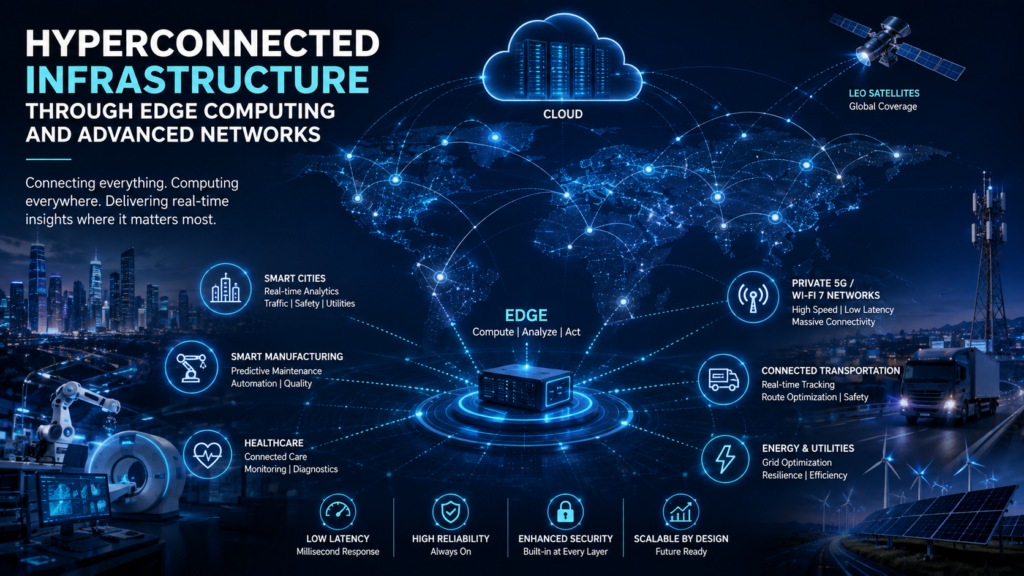
It will be a few years before we start to see more organizations migrate to what I would refer to as ‘hyperconnected’ infrastructure. This model will bring together cloud and edge computing, latest generation Wi-Fi such as Wi-Fi 7, private 5G networks, software defined networking (SDN), Low Earth Orbit (LEO) satellites, and AI / Machine Learning (ML) for network management within a ‘hyperconnected’ platform or ecosystem of applications and services that are delivered via this platform. Note that this network will be able to monitor and manage itself in real time. That is to say it will automatically sense any problems and fix them before they impact on users.
By 2024, most organizations, large and small, are expected to adopt so-called hyperconnected infrastructure: a combination of cloud and edge-based platforms which are to be connected by Wi-Fi 7, private 5G networks, SDN, LEO satellites and AI-based management software (IDC, 2024).
In support of the hyperconnected infrastructure, edge computing will enable organizations to process information in real time at the location where the information is generated. The information generated by organizations is increasing on a daily basis as organizations strive to support their increasingly digital operations. Processing the information in centralized data centers or cloud platforms will become increasingly slower and for many applications a slight delay can cause problems and have a negative impact on business. Thus, it is increasingly important for companies to process information in real time at the edge of their network.
Looking ahead to data in the future, there will be a lot of edge computing going on. As stated above, Edge computing refers to the process of moving processing closer to where data is generated. As organizations process increasing amounts of information to be used for a variety of operational purposes, it is becoming clear that waiting for information to travel to cloud data centers located far from where the information was generated can create problems including increased latency and reduced use of available bandwidth. In some cases, the ability to respond to events as they are occurring can even be lost. All of these problems can be addressed by performing analysis on data that is generated close to where it is collected and processing the results in real time before sending information to cloud computing environments for storage, as shown in International Data Corporation’s (IDC) 2024 Future of the Network Report , shown at right. In addition to the improved performance, the increased local processing provides organizations with a means to perform additional functions and create new opportunities to gather and process data, in turn providing more insights and better operational decisions.
Several industries have already seen how Edge Computing can bring added value. For example, manufacturers can collect data from production lines and in real time control and monitor the relevant equipment and processes. Healthcare organizations can in real time process data from patient and equipment monitoring and as a result of this can provide immediate clinical action as a patient’s condition rapidly changes. Retailers can gather customer behavior information in a store while a customer is still there to offer them a more personal shopping experience and to make the best stock and inventory decisions. Transport, utility and public safety organizations can use Edge Computing because for them time is of the essence and in their situations processing of data in real time is critical as they cannot afford to have data travel to a cloud environment and then back again. In addition, they require to act in real time as situations unfold.
For industries such as Transportation, Transportation, Utilities and Public Safety there are also many applications where it is critical to be able to react in real time to current situations. The distance to a cloud platform and back would take too long, so Edge computing is critical to support current and future applications in these industries.
Another capability that is rapidly maturing is the ability of intelligent networks to manage themselves. In addition to detecting a blockage before it affects users, intelligent networks can now also optimize traffic flow on the network, recognize unusual behavior, forecast future requirements, and recommend the right upgrades and changes to ensure optimal performance. This means that the function of network management is evolving from being a largely reactive function that fixes problems as they occur, to a more proactive function that prevents problems from occurring in the first place. As the functions of the network become increasingly intelligent, the function of network management is also becoming increasingly intelligent, and as a result is becoming a function that requires less and less manual intervention over time.
As the technologies of networking evolve, the work of the network professional will change dramatically. Initially this new set of technologies will present themselves to the network professional as a new set of problems to be fixed i.e. the new ‘business as usual’ of troubleshooting performance issues. However, as the various solutions become more established the network professionals will start to architect and manage a platform of intelligence that automatically makes a decision based on a number of factors including risk and also is aligned to business priorities.
In summary, for most emerging technologies the network will become an increasingly important component. AI applications require high performance for distributed training and inference; digital twins need large amounts of sensor data to function properly; Autonomous Vehicles and Industrial Robots need very low latency to function safely; Cloud Native Applications require a network of connections that can function in many different technology environments; and, most importantly, for the growing number of hybrid employees, there is a need for secure and reliable access to enterprise systems and data from anywhere.
These new technologies depend on the modern network for their optimal functioning. The network is no longer simply a means to an end but rather a strategic asset to the organization,
Leaders must change their perspective on the network. As recently as the last few years, the network was perceived to be a cost of doing business to support users and applications. Today, the network is a strategic asset that will determine how quickly an organization can bring to market new applications and services and scale as required.
Modern Networking is no longer just the purchase of the latest hardware or an increase in bandwidth in order to keep business running as usual and employees productive. The Network is a strategic asset. The investment in modern Networking has a direct impact on the speed with which a company can innovate, grow and react to changing circumstances.
From my 30+ years of experience as an IT Executive of large enterprises, I have found that, network modernization, in itself, can lead to numerous more changes and utilize cloud, AI, analytics and automation to further enhance performance of an organization, once they have flexible, intelligent and robust network in place.
The network is no longer supporting the modern digital enterprise; the network is the platform on which the modern digital enterprise is being built.
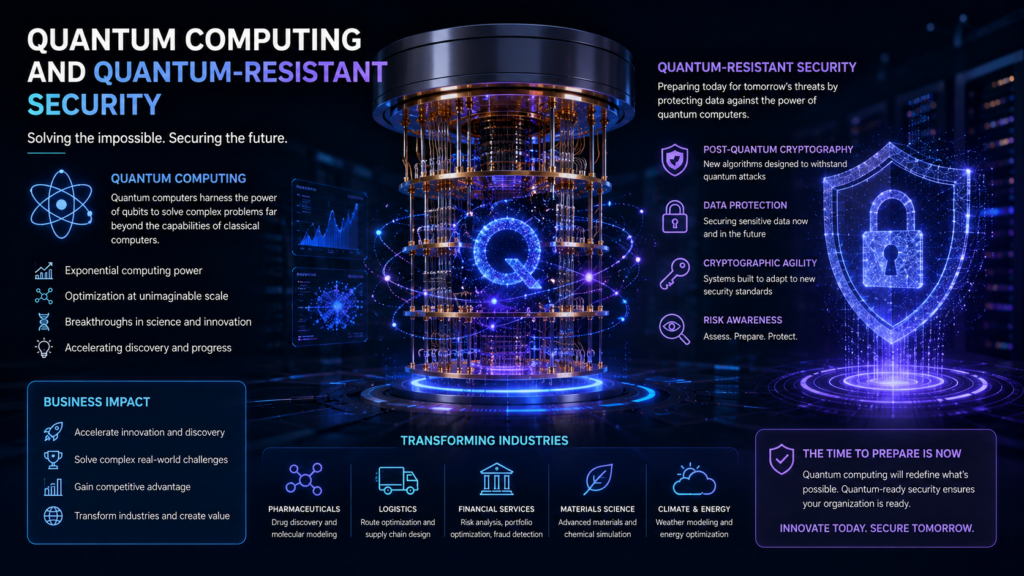
Emerging technologies currently grabbing the attention of business leaders include Artificial Intelligence and, of particular complexity, Quantum Computing. For the majority of currently available technologies currently in development, which are deemed to be emerging, a number of years will pass before they reach the stage of full maturity, such as the case with the development of cloud computing and its large-scale deployment. However, some of these technologies are already being given some strategic thought, in the boardroom. Quantum Computing is currently a case in point.
However, if an organization waits until the full, commercial implementation of quantum computing occurs, it will likely find that it is addressing problems that it could not have anticipated and for which it has no influence.
In stark contrast to today’s classical computers that use bits (0s and 1s) to process information, and in binary code to store information that the computer then reads and processes, quantum computers use qubits (quantum bits). Qubits are able to represent many 1s and 0s at the same time in a couple of quantum properties (superposition and entanglement). The simple fact is that a quantum computer is able to perform an enormous number of calculations in a very short space of time — far more than the world’s largest and most powerful classical computers are able to complete in a very short space of time.
A quantum computer is expected to be a very powerful tool for solving very difficult problems but it is not expected to replace the laptop or the servers in the data center, nor is it expected to replace the cloud. In the vast majority of cases, businesses will continue to run their applications on their existing classical computers for many years to come. In fact, the quantum computer is expected to be a highly specialized tool that will solve problems that classical computers are not expected to solve in a reasonable amount of time.
Pharmaceutical companies are able to greatly speed up the time consuming process of trying to discover new medicines by using quantum computers to model the interactions of individual molecules in even greater detail than before. Banks could use quantum computers to try out more scenarios when it comes to managing a large portfolio of stocks and shares. Manufacturers could use them to design materials that are stronger, yet lighter, and are also better for the environment. Companies with global supply-chains could use them to try out countless different scenarios to find the optimal way of getting their products to their customers all over the world. And, the Aerospace and Energy industries are likely to find many uses for quantum computers as well.
The next areas where there are opportunities for large gains are in Aerospace, energy, and advanced manufacturing. Each of these industries will be able to take large gains first and this will be the aerospace industry as the amount of computations needed to simulate the material properties at the atomic level is so much greater than is currently possible with classical computers. The Aerospace organization will not use the Quantum Computers for their daily work but for those special situations where a huge amount of computations are required and can be done in a very short period of time.
Even in the short to medium term, there is a risk that the opportunities to apply quantum computing could arise very quickly. And for this reason, many challenges will arise. The main area of application for quantum computers in the medium-term will be to solve problems that are currently too hard for classical computers. Here, problems which can be solved in principle using a classical computer but which would take an unacceptable amount of time to complete in practice. In the vast majority of business applications, classical computers will continue to be the default computing platform for the foreseeable future. However, for certain specific problems, quantum computers will be able to deliver answers that are far faster than even today’s supercomputers are able to. Large pharma will be able to carry out drug research much faster than before. Financial services will be able to evaluate complex portfolios more quickly and with greater accuracy. Manufacturers will be able to simulate the properties of materials under stress much more effectively than before.
It is worth noting that there are some concerns by information security experts that a sufficiently powerful quantum computer could ‘break’ all public key cryptographic systems currently in use, including for example most implementations of RSA and some (but not all) implementations of ECC well before such a computer could be put to any other useful work. If the number of years before a threat to information becomes manifest and the number of years before such a threat materializes are both very large, then it is possible that a strategic threat to information currently manifest today could be addressed today. And, since information of strategic value to an organization is a vital asset of that organization, it would clearly be prudent for such an organization to start to address any long-term threats to that information today.
Another class of attack has received considerable publicity as the potential for a “harvest now, decrypt later” exists for many years.
The risk of “harvest now, decrypt later” exists today for organizations that protect Intellectual Property, classified information, financial data that contains financial information, health information or personal information that contains Personal Identifiable Information (PII) and must be kept confidential for many years.
On the positive side, there is already considerable work in progress in post-quantum cryptography, and, as mentioned above, NIST has recently completed the first phase of the process of developing new standards for such cryptography. In that process, five promising algorithms were selected to be made available for public comment in the next phase of the process. All of these algorithms are designed to be resistant to both classical and quantum computing attacks, and thus could be used to replace cryptography based on number theoretic problems with cryptography based on other hard problems that are thought to be resistant to quantum computing. And while there will no doubt be many years of work ahead of us in order to migrate the large number of systems that currently use such number theoretic based cryptography to systems that use cryptography based on other such hard problems, now at least we have a clear road map for that work.
Your organization needs to determine how long sensitive data needs to be kept confidential, if the cryptography currently used on your computers and in your applications will be able to withstand an attack from a powerful quantum computer, and how your software and technology vendors plan to support the new post-quantum cryptography standards required. How hard will it be to add the new cryptography to your current systems as new standards and methods become required?
Understanding the risk that your cryptography could be broken by a quantum computer, the length of time that you need to keep certain data confidential, whether your software and technology vendors have a plan to support post-quantum cryptography and how difficult it will be to swap out new encryption for your current systems are all things that you should understand and start to plan for today.
Viewing the need to be ready for quantum computing from a risk management perspective, it is not just a new and upcoming security problem to deal with for a while. It will be a long-term enterprise problem that will have to be dealt with in an organized and structured way. We usually spend a lot of time preparing for unlikely events such as a natural disaster, a supply chain getting cut off, or changes in laws and regulations that affect an enterprise. Quantum computers in the future will be no different.
There is no strategy in waiting for a mainstream market to mature for this technology. The strategy for dealing with this technology is to manage the risks as with any other technology, and hope that one has the time, money, and flexibility to deal with the problems as they come.
Most decisions have some degree of uncertainty. Even the best decision, made with the best information, contains some degree of risk. Every major investment, every major growth initiative, every fix to the supply chain, every attempt to mitigate risk of operational failure requires information to make that decision. Typically, this information consists of historical data in the form of reports, financial information, and most importantly, the years of experience of senior executives who have made similar decisions in the past.
Historical reports, financial reports and senior executives’ experience are the best information available to support an executive’s decision-making. However, the fact remains that no one has a crystal ball and can only make the best possible decision based on the information available at the time the challenge arises. This is where the use of digital twins can provide additional value.
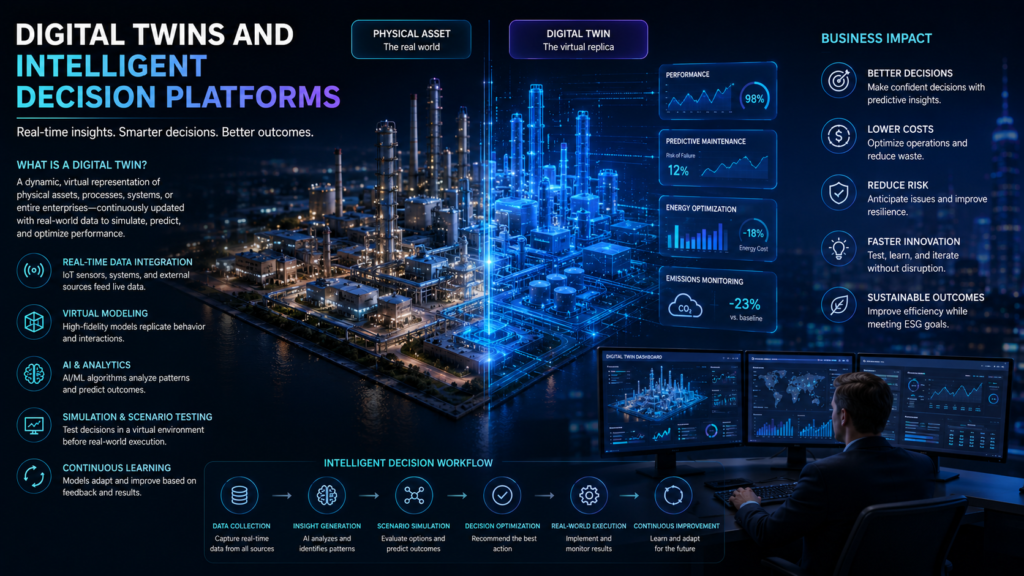
The concept of Digital Twins originated in Engineering and Manufacturing where Virtual Replicas or Virtual Copies of physical objects and processes were created. However, for the purpose of enterprise decision making, Digital Twins of entire enterprises themselves are being created. These Virtual Copies of enterprises are continually updated with the latest data from across the organization, enabling monitoring, analysis and real time simulation of possible future states (Tao et al., 2019).
Most importantly, the digital twin of an object, process or of a whole organization, moves an enterprise from monitoring and measuring (i.e., from understanding what is happening) to a predictive mode, whereby, by using AI, advanced analytics and real-time data from the operations, the organization can understand what the potential outcomes of its future decisions will be before they actually happen and before their consequences materialize in the real world.
While it is not possible to predict the future with 100% certainty, better information enables better decisions and the digital twin, coupled with a sophisticated data set, predictive analytics and AI, helps to test potential scenarios, enabling the best course of action to be identified prior to implementation.
Applications of DTs for organizational performance monitoring are spreading to many industries and are being used in many different types of organizations. They can be very useful for manufacturers of all types by allowing the owner or manager of a company to simulate out future production using a DT to test out as many different scenarios as needed, to test out different ways of modifying an existing assembly line or for modifying a number of other physical assets that are used by a company. A DT can also be used by the departments of a hospital in order to compare projected numbers of patients with a proposed staffing configuration. This is also true for a large public or private utility. Such an organization could use a DT to create a model of their electrical grid and then test out the anticipated performance of the grid during a number of different weather scenarios. In addition, the department of transportation for a state or region could create a DT to monitor traffic flow on the roads and highways of that area of the country. This would enable the owner or manager of a company to test out a number of different scenarios and then redesign a given road or set of roads in the most optimal fashion possible. A Supply Chain Management group can also use a DT to test out different combinations of suppliers in order to find out which will perform the best before any problems arise which could be caused by a major political conflict. For example, a major political conflict could cause problems with receiving goods from a number of different suppliers. In order to receive the best performance possible from a supplier it would be wise to test out as many different suppliers as possible before entering into a contract with any of them.
A further trend that is currently gaining more and more acceptance is the use of digital twins for the simulation of cyber-attacks on networks, systems and entire organizations. IT-security experts use digital twins in order to test network, systems and processes for potential security gaps as well as to test and optimize their IT security strategies in a realistic manner. Digital twins are used in a safe environment to test out a wide variety of different scenarios and to find out in advance how an attack could unfold in the network and what consequences it may have.
The digital twin in conjunction with AI, is used to continuously analyze a large volume of data that describes the operation of physical assets and/or organizations. It can identify abnormal behavior, make predictions, suggest improvements, optimize the current use of resources and even come up with measures to correct negative effects that have already occurred. In essence, the digital twin is not just a simple virtual replica of a physical asset or organization. It has become a powerful decision-support system (Porter & Heppelmann, 2015).
A logistics company might use a digital twin to plan for product distribution during very inclement weather. The digital twin would test and simulate dozens of distribution plans. It would score each plan on dimensions like cost, expected delivery performance, potential for bottlenecks, and so on. The organization could then select the best plan of action and put it into place before the distribution actually occurs.
In summary, within various domains (healthcare, manufacturing, financial services, energy, retail, government and public sector), Digital Twins serve the core value proposition to support executives of organizations in better preparing themselves and in making better decisions, by allowing them to test and assess the consequences of their decisions before it is too late and before any damage is done.
The greatest value that the Digital Twin brings to the toughest of executive decisions is to reduce uncertainty, or better said, risk of the worst. The best information, in turn, equals the best decision. Developing a model of current data from all of an organization’s operating assets – using advanced predictive analytics and/or AI – would enable an organization to go through dozens of possible future states leading to far superior strategic decisions than would have been the case had the organization relied on historical information and the good experience of the CEO and other senior leaders.
Decisions, even with the best available information, have always carried a degree of risk for leaders, be they executives or line managers. As leaders using digital twins, you will continue to rely on your experience and make the best decisions but, with the aid of digital twins, you will make them with far greater knowledge of potential outcomes than is currently the case.
As digital transformation becomes the new business as usual in various industries, digital twins will move from being engineering tools for manufacturing physical objects to models of entire businesses to support decisions and test strategic options. New use cases will arise in finance to examine economic scenarios, in healthcare to improve operations and patient outcomes, in emergency preparedness and in large infrastructure investments in government.
At its core the Digital Twin is a simple tool to support a leader with his or her decision making. The technology that is required to build and operate a Digital Twin is quite complex but the value that it brings to the leader and organization is simple. It allows the leader to see possibilities and understand potential risk before any negative consequences actually occur.
Looking at the Bigger Picture
The previous comments noted the value that each of the technologies will continue to bring but summed together they will deliver a value significantly greater than that of the sum of the individual technologies. As has been noted agentic AI continues to operate in ever more sophisticated ways and this is thanks to intelligent (autonomous) networks. The operation of autonomously operated technology will be dependent on quality data, provided by connected ( intelligent) infrastructure. Digital twins are able to utilize AI and/or Edge Computing to transform the vast volumes of data being generated by connected physical systems into high value insight – potentially even allowing vast optimization to take place utilizing Quantum Computing.
The convergence of new technologies to create new and innovative ways of producing new capabilities in an interconnected and interdependent manner is what makes this time so special. Unlike buying and using isolated tools to solve isolated problems, organizations are now building the core of future competitive ecosystems of interrelated and interdependent capabilities.
The future will be created by a new generation of leaders that are able to continue to unlock value from a set of critical technologies over a long period of time. However, the future will be enabled by more than one technology, it will be enabled by companies that build a set of related technologies, develop an integrated strategy for them and make the necessary investments in talent, governance and in an able workforce that is able to go work in an ecosystem of related technologies and work in a number of different settings.
Common Themes Across All Five Technologies
All 5 of these emerging technologies are very different from each other, yet there are also commonalities among them. Most importantly: none of them creates value on its own.
A lot of these emerging technologies require very specific data or information. For example, AI is only as good as the data that’s been provided to it. Digital twins require intelligent networks and then a lot of continuous real-time telemetry information from a huge number of different sensors. Autonomous systems require a lot of mature governance as well as really effective business processes. And, as I said before, quantum computing will depend on a lot of very specific infrastructure and information as well as domain expertise and a well-defined business problem that it can solve to add value to an organization.
In this sense, an environment is created in which all elements support the organization’s mission in digital form. The technology leaders of companies therefore should pay more attention to the digital transformation of their organization by the digital transformation of their strategy instead of the digital transformation of their company by a focus on single new technologies.
Of course, those who treat these technologies as separate projects, each to be dealt with in isolation and separately for maximum value, will likely fail to grasp the greater value available from a more strategic, coordinated approach to these technologies.
Data Will Become an Organization’s Most Valuable Asset
Data is a key element that ties these technologies together. The data used for training and training of AI, as well as the data used for decision making by AI, can contain the same errors as the human data used for making decisions. The data used for the operational monitoring of autonomous systems must be correct to make good decisions. The data that is input into the digital twin must be continuous and correct to simulate the real world accurately. The information used in predictive models and advanced analytics must be complete, consistent, and correct to make correct decisions.
However, linking these new technologies together with data is an opportunity but also a challenge for many companies. Many companies have created large amounts of data in the last years, however this data is not centrally stored, of poor quality and not used as it should be. Many companies that start automating processes or using AI first realize that the problem of the technology itself is minor and that the real problem is the data and the data governance of that company.
In summary, in order to develop technologies based on the organization’s data, the organization’s data must be improved, standardized, the data owners must be clearly defined and effective data governance must be put in place. Until this is done with the organization’s data, regardless of the number of AI or automation technologies that an organization deploys, it will not achieve its objectives because the data has not enabled the organization to make reliable decisions (Khan et al., 2014).
Cybersecurity Must Be Built Into Every Initiative
From our observations one key lesson has become apparent recently: Cybersecurity is no longer a workstream that can be added to a project after the design of the new system has been finalized. It has to be integrated in the architecture of the system from the very beginning.
New attack vectors are introduced by AI such as prompt injection attacks and model tampering as well as unauthorized access to training data and the misuse of automated processes and services. Edge computing on the other hand creates a lot of new endpoints which are not in the traditional datacenter. Also, autonomously acting systems have severe consequences when the decision making process is compromised. And last but not least, quantum computing will force organizations to re-think most of the encryption that is today in use to protect sensitive information.
For leading organizations the approach of secure-by-design comprises Security, Privacy, Resilience and Governance for all phases of the technology lifecycle. Thus risk is reduced, but most importantly the confidence of customers, employees, of regulators and of partners and competitors is increased (National Institute of Standards and Technology [NIST], 2024).
Governance Is Becoming a Strategic Advantage
The current hype around Artificial Intelligence (AI) is already putting the governance of this technology in the focus. However, more is needed than the current state of affairs. As with every technology, a wide range of questions will arise with its introduction, such as: how is one to hold accountable the AI system? How transparent is it? How does one ensure that the technology is ethical? How does one comply with rules and regulations? And how does one even exert control? The intelligent and autonomous systems that are increasingly being integrated into business processes demand answers to these questions at an exponential rate that is exponentially greater.
Governance is not a dirty word for bureaucracy stifling implementation. On the contrary, good governance is what enables responsible innovation. Effective governance clearly defines the roles of individuals and functions, sets the right tone for technology usage, sets boundaries and decision rights and holds people accountable. Thus the executive has confidence in the output of technology and the regulator has confidence that appropriate safeguards are in place and being executed. Therefore, it is the organizations with strong governance that are best equipped to capitalize on emerging technologies not the ones that focus on speed of implementation (World Economic Forum [WEF], 2025).
When businesses have governance frameworks in place that allow them to adopt new technologies effectively, they are more likely to continue to successfully utilize these technologies than their counterparts who are solely focused on quickly implementing new technologies. Consistency, accountability and trust are becoming increasingly important as technology continues to become more deeply ingrained in businesses and their processes, and a strong governance framework is the key to achieving these aspects. (World Economic Forum (WEF), 2025)
Technology Will Always Be About People
A historical lesson learned long ago is that technology in itself has never created sustainable competitive advantage. Yes, every major technological breakthrough in history was followed by very useful applications to real problems that many people found to have real value.
Leading AI is not the same as great leadership. There is no technology that can sort out an organization’s highly inefficient processes. Networking within and between departments is not going to solve all of the communication problems that arise from a siloed organization. Information from a digital twin contains no value to leaders, until it improves their decisions. Ultimately there is no technology of value to business until it has an objective that it can solve for using the technology.
Technology extends what people can do. Therefore, it is people who are responsible for leadership, good judgment, creativity, ethics and vision for their business. Investing in a workforce as much as one invests in technology for digital transformation is key to gaining a competitive advantage. Investing in a workforce intentionally is far more important than an entirely technical approach to technology (Vial, 2019).
Recommendations for Executives
So where to start? Firstly, each organization needs to identify where to begin and what is key for them the most important starting point. As a rule of thumb for most organizations it is recommended to start preparing for future technologies in several steps.
- Start to develop an actual enterprise AI strategy. There are many running isolated pilots, but few (if any) actual strategies for business objectives, governance and workforce strategies to support them to scale (Dwivedi et al., 2023).
- Build the necessary supporting enterprise infrastructure (e.g. cloud-native platform, intelligent enterprise network, edge computing), and a robust Cybersecurity architecture capable of supporting future threats and their corresponding attacks.
Security should be treated as a business discipline, not as the remit of the IT department. Zero Trust networks, identity security and continuous monitoring and intelligence should be implemented and run. In addition, an organization’s risk management strategy must include preparation for post-quantum cryptography (NIST, 2024).
Fourth, you need to invest in your workforce. New technologies are changing so fast and so fundamentally that traditional learning and development will be unable to keep up. Enterprises therefore will need to establish a variety of different programs that will support employees in acquiring the skills that are required for them to fully exploit new technologies. This would include knowledge of how to use AI and data analytics as well as key cybersecurity skills, systems thinking, and the ability to work effectively across functions. While there will be great value in having knowledge of individual new technologies, the ability to learn to apply new technologies very quickly will become a major source of advantage in the enterprise (World Economic Forum, 2025).
An experimental culture within an organization is key for it to continue to grow, by all employees being given the opportunity to test and to develop new technologies and new ways of working. It is true that not all pilots will be successful, and it is also true that there is no guarantee that new technologies quickly will be able to generate a return on investment. But it is just by learning from failures and continue to improve that those organizations are best prepared for whatever the future will bring.
Wrapping Up
Historic moments in business history have spawned the revolution of new ways in how companies operate to generate growth and prosperity. Be it the Industrial Revolution for mass production of goods, personal computers for work places, the Internet for communication and commerce, or the recent Cloud-Computing era which has enabled new business models for software and technology, in how they can be developed, sold, and even consumed.
My excitement in the history of business comes from the fact that currently we are going through a huge transformation similar to past revolutions. This time however, as opposed to one innovation, we are experiencing a convergence of a group of very powerful technologies, that in a short time will affect almost every industry.
· Agentic AI will fundamentally change the nature of knowledge work, Autonomous Enterprise Operations enable organizations to anticipate problems before they occur rather than simply reacting to them, Hyperconnected Infrastructure will provide the depth and breadth of network robustness required by highly Agentic Applications, Quantum Computing will unlock new possibilities and corresponding challenges for business leaders and their Cybersecurity assumptions. Digital Twins of organizations will revolutionize Strategic Planning enabling leaders to test and ‘live’ out scenarios in a virtual world before committing resources to make them a reality.
Taken separately, each of these technologies has the potential to profoundly change how an organization operates. But together they provide a glimpse into the framework of a new model of the modern enterprise.
I am most excited about the opportunities for the emerging technologies to support a new operating model of the modern enterprise that is more agile and more resilient, and that creates more value for customers, employees and other stakeholders. So far, technology has always been a change driver, but always driven by others. There is always a human factor at play, and that human factor is about leadership, vision, good judgment, and, above all, being able to question assumptions, and to challenge the status quo.
As we enter 2035, it is increasingly apparent that these technologies will shape the future of business. The only question is: are today’s leaders currently preparing their organizations for this change?
I am not suggesting that a business has to be a first adopter of all new technology. However, I believe that integrating current and future technology into a business strategy is critical to a business leading in the next decade. A business can be a leader in the next decade by continuing to adapt to change in an ever faster business environment by investing in people, good governance and by having a business strategy that can be used in conjunction with current and future technology.
And they will create the future, not just manage to keep up with it.
References
Brynjolfsson, E., Li, D., & Raymond, L. R. (2023). Generative AI at work (Working Paper No. 31161). National Bureau of Economic Research. https://doi.org/10.3386/w31161
Dwivedi, Y. K., Hughes, L., Baabdullah, A. M., Ribeiro-Navarrete, S., Giannakis, M., Al-Debei, M. M., Dennehy, D., Metri, B., Buhalis, D., Cheung, C. M. K., Conboy, K., Doyle, R., Dubey, R., Dutot, V., Felix, R., Goyal, D. P., Gustafsson, A., Hinsch, C., Jebabli, I., … Wright, R. (2023). So what if ChatGPT wrote it? Multidisciplinary perspectives on opportunities, challenges and implications of generative conversational AI. International Journal of Information Management, 71, 102642. https://doi.org/10.1016/j.ijinfomgt.2023.102642
Frank, A. G., Dalenogare, L. S., & Ayala, N. F. (2019). Industry 4.0 technologies. Implementation patterns in manufacturing companies. International Journal of Production Economics, 210, 15-26. https://doi.org/10.1016/j.ijpe.2019.01.004
International Data Corporation. (2024). Worldwide edge spending guide.
Khan, N., Yaqoob, I., Hashem, I. A. T., Inayat, Z., Mahmoud Ali, W. K., Alam, M., Shiraz, M., & Gani, A. (2014). Big data. Survey, technologies, opportunities, and challenges. The Scientific World Journal, 2014, Article 712826. https://doi.org/10.1155/2014/712826
National Institute of Standards and Technology. (2024). Post-Quantum Cryptography Standards. https://www.nist.gov/pqcrypto
Porter, M. E., & Heppelmann, J. E. (2015). How smart, connected products are transforming companies. Harvard Business Review, 93(10), 96-114.
Raisch, S., & Krakowski, S. (2021). Artificial intelligence and management. The automation-augmentation paradox. Academy of Management Review, 46(1), 192-210. https://doi.org/10.5465/amr.2018.0072
Sarker, I. H. (2022). AI-based modeling. Techniques, applications and research issues toward automation, intelligent systems and smart data-driven decision making. SN Computer Science, 3, 158. https://doi.org/10.1007/s42979-022-01043-x
Tao, F., Zhang, H., Liu, A., & Nee, A. Y. C. (2019). Digital twin in industry. State-of-the-art. IEEE Transactions on Industrial Informatics, 15(4), 2405-2415. https://doi.org/10.1109/TII.2018.2873186
Vial, G. (2019). Understanding digital transformation. A review and a research agenda. The Journal of Strategic Information Systems, 28(2), 118-144. https://doi.org/10.1016/j.jsis.2019.01.003
World Economic Forum. (2025). The Future of Jobs Report 2025.